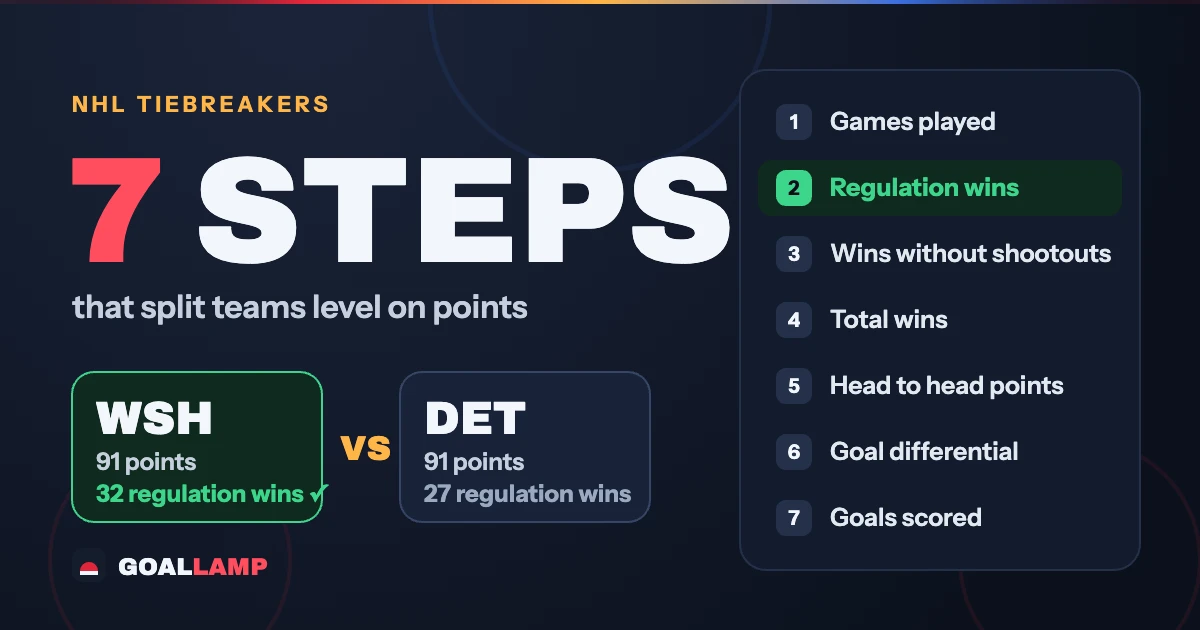
Teams level on points are split by seven steps, in order. Fewer games played comes first, then regulation wins, then wins without shootouts. Total wins, head to head points, goal differential and goals scored follow.
The NHL ranks teams by points. A win earns 2 points, and an overtime or shootout loss earns 1. When two teams have the same total, NHL tiebreakers decide who ranks higher, in the order the NHL lists them.
Regulation wins did that job in every final tie of the last five seasons. They have handed out wild cards and division places.
How NHL tiebreakers work
NHL tiebreakers run one step at a time. The first step where the teams differ sets the order, and the later steps are skipped.
The NHL lists seven steps, in this order:
- Fewer games played. The team that reached the same points in fewer games ranks higher. On the last day, every team has played all 84 games.
- Regulation wins. Only wins inside 60 minutes count. NHL.com shows them in the RW column.
- Wins without shootouts. Regulation and overtime wins count, and shootout wins do not. NHL.com lists them as ROW.
- Total wins. Every win counts here, shootouts included. This is the W column.
- Head to head points. The points the tied teams earned in their games against each other.
- Goal differential. Goals for minus goals against over the whole season. NHL.com lists it as DIFF.
- Goals scored. Total goals for over the whole season, the GF column.
Where the seven steps are used
The same steps rank teams inside a division and in the wild card race. They also set the order of each conference.
Sixteen teams make the playoffs, per the NHL playoff format. The top three in each division get in, plus two wild cards from each conference.
Home ice in the first two rounds goes to the team that placed higher in the regular season standings. A tie on points there runs through the same seven steps.
Split two teams with the tiebreaker checker
Pick a real tie from the last five seasons or two teams from today's standings. The checker shows which step splits them.
2023 to 24, East: Washington Capitals and Detroit Red Wings, 91 points each
| Step | WSH | DET |
|---|---|---|
| 1Games playedfewer ranks higher | 82 | 82 |
| 2Regulation winsRW | 32 | 27 |
| 3Wins without shootoutsROW | 36 | 38 |
| 4Total winsW | 40 | 41 |
| 5Head to head pointsgames against each other | Not needed | Not needed |
| 6Goal differentialDIFF | -37 | +4 |
| 7Goals scoredGF | 220 | 278 |
Step 2, regulation wins, decides it: 32 to 27. Washington Capitals finished 2nd wild card in the East. Detroit Red Wings missed the playoffs.
Steps from the NHL tie breaking procedure. Final numbers from NHL standings.
Steps from the NHL tie breaking procedure. Head to head games from the NHL schedule.
What each step counts
The first four steps come from a team's own record. Step 5 looks only at the games between the tied teams, and the last two use goals.
Regulation wins and ROW
A shootout win earns 2 points, the same as any other win. It counts at step 4, total wins, but not at steps 2 or 3.
That order rewards teams that win inside 60 minutes. In 2025 to 26, Philadelphia had 43 wins and Pittsburgh had 41, and both finished with 98 points.
Pittsburgh had 34 regulation wins to Philadelphia's 27. Pittsburgh finished 2nd in the Metropolitan Division, and Philadelphia finished 3rd.
Head to head points and the odd game
Step 5 counts only the games between the tied teams. A win earns 2 points and an overtime or shootout loss earns 1, as in the standings.
Teams do not always play an even number of games against each other. With an odd number, the NHL drops one game. It leaves out the first game played in the city that hosted the extra game.
Say Toronto and Boston played three times. The NHL would work it out like this:
- Toronto hosted two of the games, and Boston hosted one.
- Toronto hosted the extra game.
- The first game played in Toronto is left out.
- The other two games count, one in each city.
Three or more teams level
With three or more teams tied, steps 1 to 4 work the same way. Step 5 changes. The NHL uses the share of available points each team earned against the other tied teams, and odd games are left out.
The 2025 to 26 season ended with a three way tie in the West. St. Louis, Nashville and San Jose all finished on 86 points.
Regulation wins set the order at step 2. St. Louis had 33, Nashville 28 and San Jose 27. None of the three made the playoffs.
Goal differential, goals scored and shootouts
Steps 6 and 7 count the whole season, overtime goals included. The NHL counts a shootout win as one goal for and a shootout loss as one goal against.
Here is the effect for a team that won 3 shootouts and lost 1:
- The 3 shootout wins add 3 goals for.
- The 1 shootout loss adds 1 goal against.
- Together they add 2 to its goal differential.
NHL tiebreakers in the last five seasons
Fifteen conference ties stood when the regular seasons ended from 2021 to 22 through 2025 to 26. Regulation wins split every one of them, so steps 3 to 7 were never needed.
This table shows the four ties that set a playoff spot or a division place:
| Season | Teams level | Points | Regulation wins | What it decided |
|---|---|---|---|---|
| 2025 to 26 | Tampa Bay, Montreal | 106 | 40 to 34 | Tampa Bay 2nd in the Atlantic, Montreal 3rd |
| 2025 to 26 | Pittsburgh, Philadelphia | 98 | 34 to 27 | Pittsburgh 2nd in the Metropolitan, Philadelphia 3rd |
| 2024 to 25 | St. Louis, Calgary | 96 | 32 to 31 | St. Louis took the last West wild card |
| 2023 to 24 | Washington, Detroit | 91 | 32 to 27 | Washington took the last East wild card |
The two closest calls came right at the playoff line.
Washington and Detroit, 2023 to 24
Both teams finished with 91 points in 82 games. Detroit had more total wins, 41 to 40, and more wins without shootouts, 38 to 36.
Detroit also had the better goal differential, plus 4 against minus 37 for Washington. None of that counted, because step 2 comes first.
Washington had 32 regulation wins and Detroit had 27. Washington took the 2nd wild card in the East, and Detroit missed the playoffs.
St. Louis and Calgary, 2024 to 25
St. Louis and Calgary both finished with 96 points. St. Louis had 32 regulation wins, and Calgary had 31.
That one regulation win gave St. Louis the 2nd wild card in the West. Calgary missed the playoffs.
NHL playoff tiebreakers and home ice
Fans often look up NHL playoff tiebreakers in April. A playoff series has no tiebreak, because it ends when one team wins four games.
NHL playoff tiebreakers work before the series start. They decide the last playoff spots and which team opens a series at home.
In the conference final and the Stanley Cup Final, home ice goes to the better regular season record. The NHL playoff format sets that rule.
A team chasing a spot can check its pace with the NHL playoff pace calculator. It compares any record with every cut line since 2013.
How to read NHL standings tiebreakers
NHL standings tiebreakers use columns you can see in the NHL.com standings. You can check a tie yourself in four steps:
- Find the teams with the same points.
- Compare games played. Fewer ranks higher.
- Compare RW, then ROW, then W.
- Stop at the first column that differs.
Head to head points come from the games between the two teams. The checker above adds them from the NHL schedule.
Tiebreaker questions fans ask
What is the first NHL tiebreaker?
Fewer games played comes first during the season. By the last day, every team has played the same number of games. Regulation wins then become the first real test.
Do NHL tiebreakers use head to head first?
No. Head to head points are step 5. Games played, regulation wins, wins without shootouts and total wins all come before them.
Do shootout wins count in a tiebreaker?
Shootout wins count only at step 4, total wins. Steps 2 and 3 leave them out, and a shootout win adds one goal for at steps 6 and 7.
Is points percentage an NHL tiebreaker?
The NHL ranks teams by points. Points percentage only shows up through step 1, where the team with fewer games played ranks higher.
What if teams are level on all seven steps?
The NHL page lists seven steps and stops there. In the last five seasons, no final tie needed more than step 2.
Take your shot
Two teams finish on 96 points. One has 32 regulation wins. The other has 31 regulation wins but 3 more total wins. Who ranks higher?
Pick one to take your shot.
Checked against the NHL tie breaking procedure
NHL standings, 2021 to 22 through 2025 to 26
NHL playoff format
Checked November 2026