NHL overtime rules change between the regular season and the playoffs. A tied regular season game gets up to 5 minutes of 3 on 3 overtime. The first goal wins. If nobody scores, a shootout picks the winner. The winner earns 2 points, and the loser keeps 1. A tied playoff game moves to full 20 minute periods with 5 skaters a side. Those periods repeat until someone scores, with no shootout. The 2026 to 2027 NHL rulebook still lists the five minute overtime and the shootout.
This table shows how overtime works in each part of the NHL season.
| Detail | Regular season | Playoffs |
|---|---|---|
| Length | Up to 5 minutes | 20 minute periods, as many as needed |
| Players on ice | 3 skaters and a goalie per team | 5 skaters and a goalie per team |
| Before overtime | About 2 minutes while crews shovel the ice | 15 minute break, and the ice is flooded |
| If no one scores | A shootout | Another 20 minute period |
| Points | Winner 2, loser 1 | No standings points; the winner adds a win in the series |
Regular season overtime
Overtime starts once the three regulation periods end in a tie. The guide to how many periods are in hockey covers those first 60 minutes. Each team earns 1 point in the standings as soon as regulation ends tied. Arena crews then shovel the entire ice surface. No break time goes on the clock. The NHL expects overtime to start about 2 minutes after regulation ends. Players wait at their benches and cannot go to the dressing room. The teams defend the same end they defended in the second period. The first goal in overtime ends the game.
How 3 on 3 works
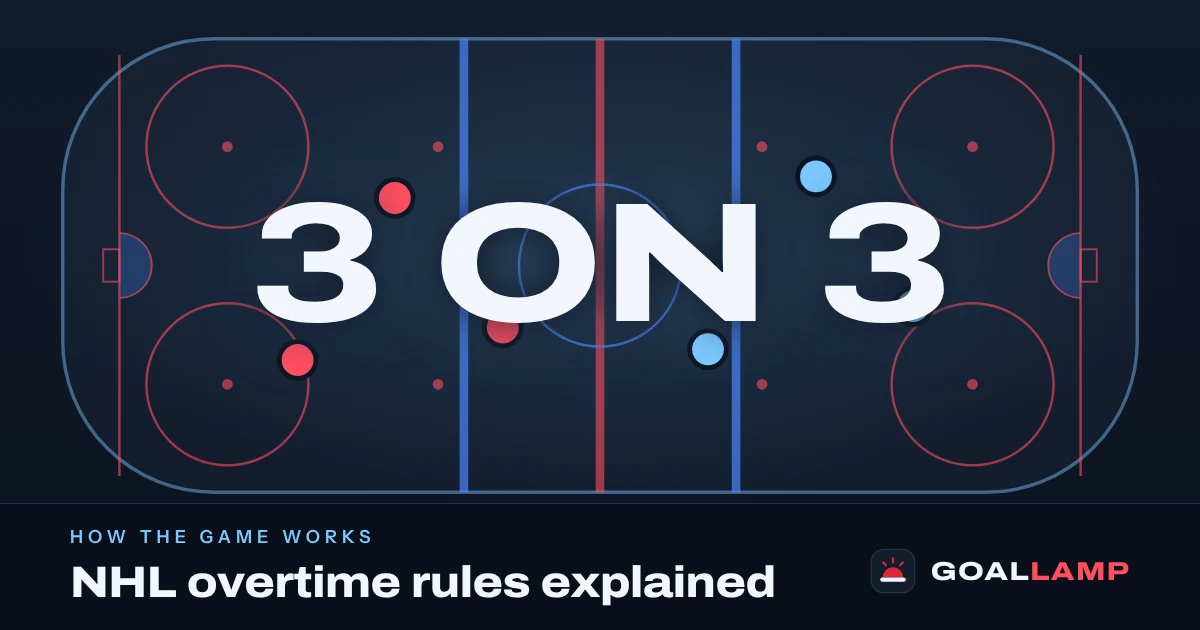
Each team plays 3 skaters and a goalie in regular season overtime. In regulation, each team has 5 skaters, so 10 share the ice. In overtime, each team has 3, so only 6 share it. That leaves 4 fewer skaters on the ice, and far more open space. The clock runs for up to 5 minutes.
A team may pull its goalie for an extra skater during overtime. The goalie then has to wait for a stoppage before coming back. Pulling the goalie can also cost a point, as the points section below shows.
Penalties in 3 on 3 overtime
A penalty in overtime gives the other team an extra skater. The penalized team keeps 3 skaters on the ice. These are the common situations:
- One team takes a minor penalty: play goes 4 on 3.
- The same team takes a second penalty: play goes 5 on 3.
- Both teams take minor penalties at the same stoppage: play stays 3 on 3.
- A 4 on 3 power play ends: play goes 4 on 4 until the next whistle, then back to 3 on 3.
- A 5 on 3 ends: at the first stoppage after it, play returns to 4 on 3 or 3 on 3.
- Regulation ends 5 on 3: overtime starts 5 on 3.
- Regulation ends 4 on 4: overtime starts 3 on 3.
The 4 on 4 step comes from the penalty box. The player whose penalty ends skates straight back into the play. Both teams then have 4 skaters until the referee blows the whistle. In October 2025, the Flyers’ Trevor Zegras took a slashing penalty early in overtime. The Penguins then played 4 on 3.
An overtime power play works like one in regulation, only with fewer skaters. Rule 84.3 also says a team never has fewer than 3 skaters on the ice.
The points system
Both teams earn 1 point when regulation ends tied. The team that wins in overtime or the shootout earns 1 more point. The winner ends with 1 point plus 1 point, for 2 points. The loser keeps its 1 point. 2 points plus 1 point makes 3 points. So every NHL game that reaches overtime hands out 3 points in total.
On 15 October 2026, the San Jose Sharks beat the Nashville Predators in a shootout. Steven Stamkos had tied it 2 to 2 with one second left in regulation. The Sharks left with 2 points. The Predators kept the 1 point they earned when regulation ended tied.
One exception can cost the loser its point. Say a team pulls its goalie in overtime and loses with him off the ice. That team gives up its point. The point is safe if he left for a delayed penalty on the other team.
The shootout
A scoreless overtime sends the game to a shootout. Arena crews shovel the whole ice again before it starts. The home team chooses whether to shoot first or second, and the teams take turns. Each team gets 3 shots, unless one team locks up the win sooner. A team that leads 2 to 0 after two rounds has already won. The other team has only 1 shot left. A tie after 3 rounds moves the shootout to sudden death rounds.
The coach picks the shooters and their order. No player can shoot twice until every eligible teammate has shot. If injuries or penalties leave one team short, both teams may reuse players. Rule 84.4 bars three kinds of penalized players from the shootout.
- a 10 minute misconduct they are still serving
- a game misconduct
- a match penalty
That rule shaped the same Flyers and Penguins game in October 2025. At the end of overtime, 4 players on each team got 10 minute misconducts. Sidney Crosby was one of them, so he could not shoot. The Flyers went on to win the shootout.
Once the shootout starts, a team cannot change its goalie unless the goalie is hurt. Officials may measure a stick before or during the shootout. Teams cannot ask for a measurement after an overtime goal. Video review of shootout attempts falls under Rule 37. A team can also refuse to take part, but it then takes a shootout loss.
The final score ignores the shootout tally. The winner gets 1 goal added to its score from the end of overtime. The Sharks and Predators were 2 to 2 after overtime. Macklin Celebrini scored the only shootout goal. The game went into the books as Sharks 3, Predators 2. A 4 to 3 shootout would have given the same final score. Shootout goals also do not count in a player’s goal total.
Playoff overtime
How it works
The Stanley Cup Playoffs have no shootouts. A tied playoff game goes to a fourth period of 20 minutes. Each team keeps 5 skaters and a goalie, the same as in regulation. The first goal ends the game. If nobody scores, the teams play another 20 minute period. The rules stay the same in every overtime, from the first to the fifth.
The special overtime penalty tables in the rulebook cover only the regular season. In playoff overtime, a penalty gives the other team a normal power play. A playoff series goes to the first team with 4 wins. An overtime goal can end a series when it brings that fourth win.
Every overtime period adds 20 minutes of play. Regulation lasts 60 minutes. One full overtime brings the total to 80 minutes. Two full overtimes bring it to 100 minutes. The guide on how long a hockey game lasts covers breaks and real time.
Intermissions and ice resurfacing between overtime periods
After a tied third period, the teams take a 15 minute break. The NHL rulebook says the ice surface shall be flooded in the break between periods. The teams switch ends at the start of each overtime period.
Arena crews also clear snow during each playoff overtime period. They clean the goal creases, the end zones and the ice by the benches. The cleanup comes at the first stoppage at or after the 10:00 mark. It goes ahead even during a penalty or after an icing call.
Playoff games with several overtimes
NHL.com notes that second overtimes are not uncommon in the playoffs. Some games run far longer than that. The Flyers and Penguins played a five overtime playoff game in 2000. A fifth overtime starts only after 4 full overtime periods. Those 4 periods add up to 80 extra minutes. That is 20 minutes more than a full regulation game of 60 minutes.
How NHL overtime differs from college and international hockey
This table compares NHL overtime with the 2026 to 2027 IIHF rulebook.
| Rule | NHL | IIHF |
|---|---|---|
| Regular season or round robin overtime | Up to 5 minutes, 3 on 3 | Up to 5 minutes, 3 on 3 |
| Break before overtime | Crews shovel the ice | 3 minute break while crews shovel the ice |
| First shootout shooters | 3 per team | 5 per team |
| Shootout after that | No repeat shooter until all eligible players shoot | The same player may take every shot |
| Playoff overtime | 20 minute periods, 5 on 5, no shootout | Up to 10 minutes, 3 on 3, then a shootout |
| Title game | Same playoff rules as other games | Gold medal game: 3 on 3 periods until a goal |
Before each gold medal overtime, IIHF teams get a 15 minute break and fresh ice.
College hockey follows its own rules book. The NCAA book for 2024 to 2025 and 2025 to 2026 matched the NHL plan. Every tied regular season game got 5 minutes of 3 on 3. If nobody scored, the teams went to a shootout. Each NCAA book covers two seasons, so the current one may differ.
How NHL overtime rules have changed
NHL.com says the league has had no tie games since 2005. That year the NHL brought in the shootout to settle tied regular season games. Today the five minute overtime and the shootout belong only to the regular season. The 2026 to 2027 rulebook keeps that plan in place.
Overtime questions
Can an NHL game end in a tie?
No. A tied regular season game ends with an overtime goal or a shootout. A playoff game keeps going until a team scores.
How long is overtime in hockey?
NHL regular season overtime lasts up to 5 minutes. Playoff overtime runs in 20 minute periods with no cap on how many. Each period follows the same rules, even in a sixth or seventh overtime.
Is NHL overtime always 3 on 3?
No, only regular season overtime starts at 3 on 3. Playoff overtime uses 5 skaters and a goalie per team. Penalties can also turn regular season overtime into 4 on 3 or 5 on 3.
How many points does a team get for an overtime loss?
A team that loses in overtime or a shootout keeps 1 point. It gives up that point if it loses while its goalie is pulled in overtime. The point stays safe when the goalie left for a delayed penalty.
Do shootout goals count in a player’s stats?
No, shootout goals do not count in a player’s goal total. The winning team still gets 1 goal added to its final score.
Can a team refuse to take part in a shootout?
Yes, a team can decline the shootout. It then takes a shootout loss.