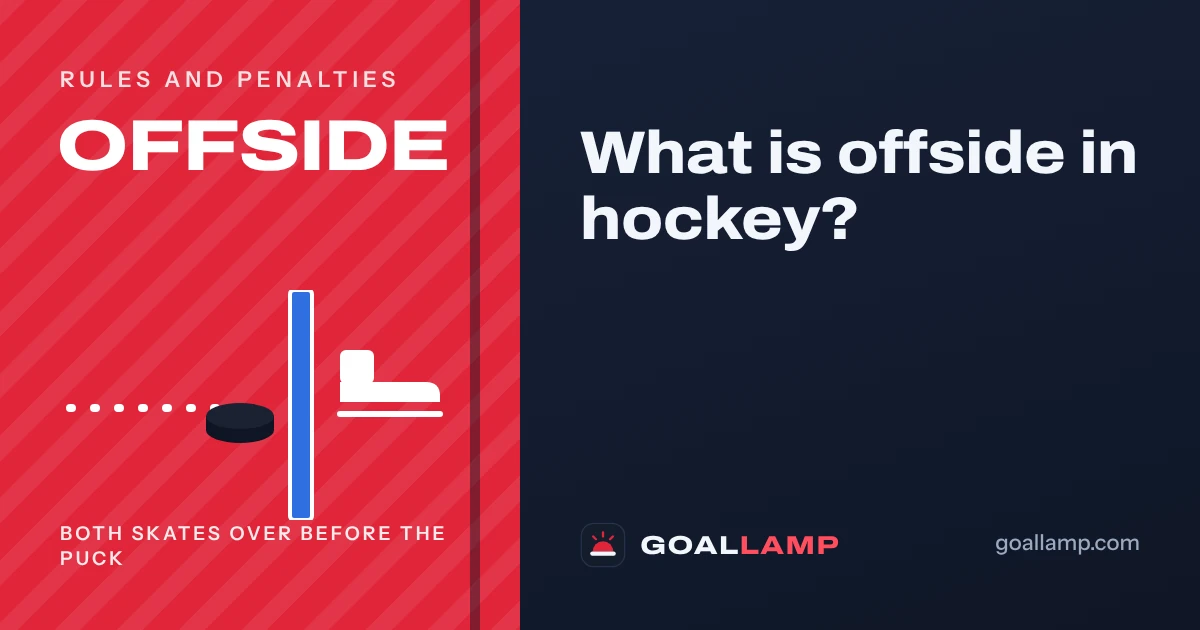
Offside in hockey happens when an attacker enters the attacking zone ahead of the puck. A player is offside if both skates are fully over the blue line before the puck. One skate on the line, or still on the near side, keeps that player onside. The linesperson then blows the whistle, and a faceoff restarts play. The NHL covers offside in Rule 83 of its rulebook.
Rule 83.1 opens with one plain order. “Players of the attacking team must not precede the puck into the attacking zone”. Every other part of the rule shows how officials judge that moment. The NHL posts its full 2026 to 2027 rulebook on its video rulebook page.
How the linesperson judges offside in hockey
The linesperson watches the skates and the puck at the blue line. The NHL rule says skate position decides every offside call. A stick over the line plays no part in it.
The puck sets the moment of the call. The rule checks each attacker at one single instant. That instant comes when the puck completely crosses the leading edge of the blue line. Until then, nobody can be offside. A puck resting on the line has not crossed it yet.
Each blue line is 12 inches wide. It sits 64 feet out from a goal line. The puck has to get all the way past that stripe.
The skate on the line rule
A skate touching the blue line at that instant keeps the player onside. So does a skate still on the player’s own side of the line. Only both skates completely over the leading edge make a player offside.
The NHL changed one detail for the 2020 to 2021 regular season. A skate no longer has to touch the line to count. The rule now uses a plane that rises straight up from the line’s leading edge. A skate in the air stays onside until it breaks that plane. NHL.com announced the change on 22 December 2020.
Possession and control
The offside rule makes one exception for the puck carrier. A player with possession and control of the puck may cross ahead of it. Rule 83.1 says his stick must control the puck before his back skate crosses. He must keep that control right after the puck enters the zone.
NHL reviews use the same test. In April 2026, Seattle challenged a Colorado goal for offside. The review found Logan O’Connor lacked possession and control when he entered the zone. The goal did not count.
Rule 83.1 adds one more case. Sometimes a defender carries or passes the puck back into his own zone. An attacker may already be inside. Officials then ignore the offside and let play go on.
Delayed offside: the raised arm and tagging up
A delayed offside starts when the puck enters the zone with an attacker already inside. The linesperson does not always whistle right away. Under Rule 83.3, the linesperson raises an arm and lets play go on.
The raised arm gives the attackers a chance to tag up. All the offside attackers must clear the zone at the same instant. A skate touching the blue line counts as clearing it. A player coming off the bench into the zone has to clear it too. The arm also drops if defenders pass or carry the puck out of the zone. Once the arm comes down, the attackers can come back in and chase the puck.
The linesperson blows the whistle if an attacker does any of these while the arm is up.
- touches the puck
- tries to win a loose puck
- pushes the puck carrier deeper into the zone
- gets close to hitting the puck carrier
NHL reviews use the same tag up idea. On 28 January 2026, a Blues goal against the Stars faced an offside challenge. The review found Mathieu Joseph had “legally tagged up at the blue line” first. Justin Faulk then carried the puck into the zone. The goal stood, and the failed challenge drew a 2:00 minor for delay of game.
A shot on goal adds one more twist. The shot that starts a delayed offside cannot score. Rule 83.4 wipes out that goal. The goal stays off even if every attacker tagged up before the puck went in. Bounces off the goalie, skaters, the boards, the glass or officials change nothing. Only a defender’s own goal, with no attacker contact, still counts.
What happens after the offside whistle
A faceoff restarts play after every offside call. The spot depends on how the puck got into the zone. Rule 83.6 lists four cases for a delayed offside.
- Carried in. The faceoff goes to the nearest spot outside the blue line the attacker crossed.
- Shot or passed in. The faceoff goes to the nearest spot in the zone where the shot or pass started. Officials pick the spot that helps the offending team the least, even after a deflection.
- Defender under pressure. When the whistle comes because an attacker pressured the puck carrier, the faceoff uses the same spot as a shot in.
- Intentional offside. The faceoff moves into the offending team’s own end.
An offside counts as intentional when a team makes it on purpose to stop play. Rule 83.7 adds one case. Say an attacker touches the puck on purpose during a delayed offside to stop play. That also counts as intentional.
Offside review and the coach’s challenge in the NHL
NHL coaches can challenge a goal they think followed an offside. Rule 38 of the rulebook covers the coach’s challenge. The NHL Situation Room then studies the replays with the officials on the ice.
Rule 38.9 sets the test for taking a goal away. The review must show an attacker beat the puck into the zone before the goal. When that happens, the goal does not count.
Rule 38.1 sets a high bar for any change. The video has to prove the call on the ice was clearly wrong. Any doubt leaves the call as it was.
A goal taken away also puts time back on the clock. The clock resets to the moment of the offside. An NHL.com review dated 15 October 2026 shows it. The Islanders challenged an Ottawa goal, and video caught Drake Batherson ahead of the puck. The clock went back to 8:10, with 11:50 played in the first period.
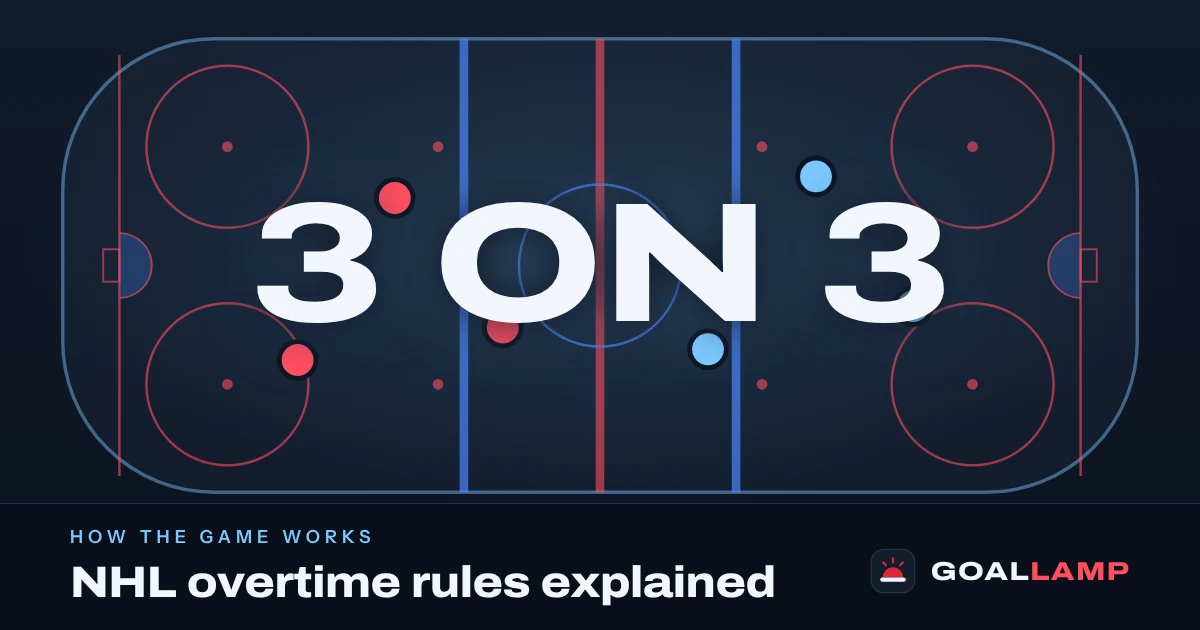
Late in games, nobody needs to challenge. The Situation Room starts its own review in the final minute of the third period. It does the same at any point in overtime. The rule covers the regular season and the playoffs. On 11 October 2026, it took away a Montreal overtime goal against Detroit. Zachary Bolduc had gone into the zone ahead of the puck. Our guide to NHL overtime rules covers the rest of the extra period.
A failed challenge costs the team that made it. The NHL gives that team a 2:00 minor for delay of game. The other team then goes on a power play. A failed Washington challenge on 14 October 2026 drew the same penalty this season. Rule 38.8 raises the cost after that. Each later failed challenge in the same game draws a 4:00 double minor.
Offside myths and facts
- Myth: The stick keeps a player onside. Fact: The NHL rule looks only at skates, so a stick over the line changes nothing.
- Myth: A skate in the air over the blue line is offside. Fact: Since the 2020 to 2021 season, that skate stays onside until it breaks the plane of the line.
- Myth: The puck only has to touch the blue line. Fact: The puck has to cross the whole 12 inch line before anyone can be offside.
- Myth: A pass across two lines is offside in the NHL. Fact: The 2026 to 2027 NHL rulebook has no two line pass rule. Its game flow section covers hand passes, icing and offside, with no rule on passing across two lines.
- Myth: The puck carrier can never beat the puck into the zone. Fact: A player with possession and control of the puck can cross the line first.
- Myth: A puck that bounces in off a defender can never be offside. Fact: Under Rule 83.2, attackers can still be offside when their play knocks the puck off a defender and back into the zone.
- Myth: If everyone tags up in time, the shot that went in counts. Fact: Rule 83.4 still takes that goal away, unless a defender scored on his own net.
How the NHL and IIHF offside rules compare
This table lines up the NHL and IIHF offside rules for 2026 to 2027.
| Rule point | NHL | IIHF |
|---|---|---|
| Rule number | Rule 83, challenges in Rule 38 | Rule 83, challenges in Rule 38 |
| Offside when | Both skates fully over the blue line before the puck | Both skates fully over the blue line before the puck |
| What counts | Only the skate blade, never the stick | Only the skate blade, never the stick |
| Skate in the air | Onside until it breaks the plane (since 2020 to 2021) | Onside until it breaks the plane |
| Puck carrier | Possession and control with the stick | Possession and control with the stick |
| Tag up | All offside players clear at the same instant | All offside players clear at the same instant |
| Failed challenge | 2:00 minor, then a 4:00 double minor for later ones | 2 minute bench minor, then 4 minute double bench minor |
Questions fans ask
Is offsides a penalty in hockey?
No, offside only stops play for a faceoff. Nobody goes to the penalty box for it. The penalty risk comes from a failed coach’s challenge, which draws a 2:00 minor.
Who calls offside in hockey?
A linesperson calls offside in hockey. That official raises an arm for a delayed offside. The arm drops once the attackers tag up. After a goal, the play can still go to video review.
What is the difference between offside and icing?
Offside and icing are separate rules, Rule 83 and Rule 81 in the NHL rulebook. Offside looks at the attackers’ skates when the puck crosses the blue line. Our guide to icing in hockey explains how the other call works.
Do youth leagues use the same offside rule?
Youth offside rules vary by league and age group. A parent should check the rulebook for the league their child plays in.