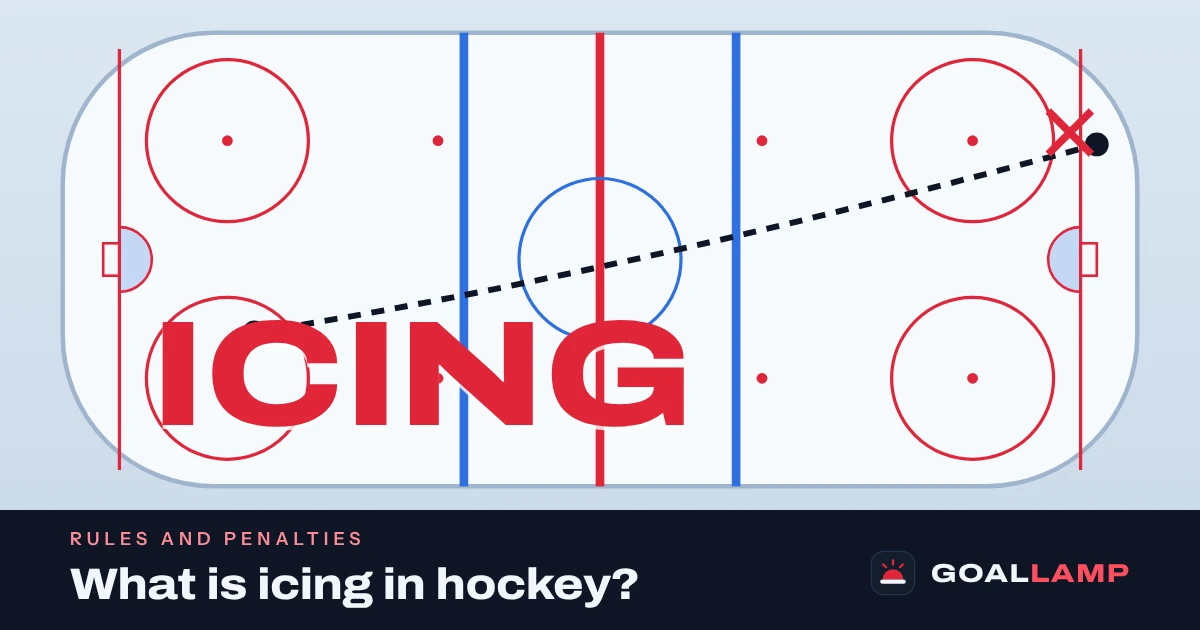
Icing in hockey is a stop in play for a long shot. A player sends the puck from his own side of the center red line. The puck then slides past the other team’s goal line. In the NHL, a linesman judges a race for the puck. If a defender would touch it first, the linesman blows the whistle. The faceoff goes back to the end of the team that iced it. A team killing a penalty may ice the puck with no whistle. Rule 81 of the NHL rulebook covers icing.
How an icing call happens, step by step
The NHL has judged icing this way since the 2013 to 2014 season. The NHL shows real icing plays in its video rulebook.
- A player shoots from his own half. The center red line splits the ice into two halves. His team has as many players on the ice as the other team, or more. The linesman looks at where that team last touched the puck.
- The linesman checks the goal line. First he decides if the puck will cross the other team’s goal line. If it will stop short, there is no icing.
- Players race for the puck. A defender skates after it to force icing. An attacker may chase it to keep play alive.
- The linesman decides at the faceoff dots. He makes his call the instant the first player reaches the end zone faceoff dots. That player’s skate is the marker. He picks the player who would touch the puck first. The rulebook treats that as a separate question from who reaches the dots first.
- A close race goes to the defender. A race too close to call is icing. If the defender would win, the whistle blows. If the attacker would win, play goes on. The same test applies when the puck slides around the end boards.
- The faceoff moves to the icing team’s end. The other team picks which of the two end zone dots to use. The NHL added that choice in 2019.
- A wrong whistle goes to center ice. Sometimes the linesman blows the whistle and the puck never crosses the goal line. The faceoff then goes to center ice.
When icing is not called
The NHL waves off icing in these cases.
- The team is shorthanded. Rule 81 only covers a team with as many players as its opponent, or more. A team killing a penalty can keep icing the puck. When a penalty is about to end, the linesman judges icing at the instant it ends. A puck shot before that moment is not icing.
- The shorthanded team broke the major penalty rule. One odd case goes the other way. A team can stay a player short after a major penalty ends. This happens when it never put a player in the penalty box to return. Rule 81.6 says that team may not ice the puck.
- The puck touched the red line on the stick. Icing is off if the puck touched the center red line on the shooter’s stick. The rulebook calls this gaining the line. A skate touch does not count.
- The puck will not reach the goal line. A puck that stops before the goal line is not icing.
- An attacker would touch the puck first. The linesman lets play go on.
- An opponent touches the puck. Icing is off if the puck touches any part of an opposing player or the goalie. That holds before or after the puck crosses the goal line.
- An opponent could have played it. Sometimes a skater on the other team could reach the puck but lets it go. Play goes on in that case. This includes a team that skips the puck during a line change to avoid a too many men call.
- The goalie goes for the puck. Icing is waved off if the goalie plays the puck, fakes a play or skates toward it. A goalie heading to the bench for an extra attacker does not count.
- The puck goes straight off a faceoff. A puck that crosses the goal line straight off the draw is not icing.
- The other team sent the puck first. Deflections are icing only if the deflecting team first sent the puck down the ice.
What the icing team loses after the whistle
The faceoff comes back to the icing team’s own end, close to its own net. The other team then picks which of the two faceoff dots to use. The NHL gives teams the same choice at the start of a power play.
The icing team also cannot change players before that faceoff. Rule 81.4 allows only three kinds of change. The team may replace an injured player. It may send its goalie back in after pulling him for an extra skater. It may also change when a penalty changes the number of players on the ice.
The icing team cannot call its timeout at that stoppage either. Rule 87.1 bars the defending team from a timeout after an icing.
Picture a team that leads 2 to 1 with 40 seconds left. One of its players fires the puck down the ice from his own end. The linesman judges that a player on the trailing team would touch it first. He calls icing. The faceoff now sits beside the leading team’s net. The trailing team picks the dot it likes best. The same tired players must stay on the ice for that draw.
Why the icing rule exists
Without the rule, a team under pressure could fire the puck away every time. The play would move far from its own net with no cost. Icing takes that escape away. The puck comes right back to the icing team’s end. A team killing a penalty keeps the escape under Rule 81.
The way the NHL judges icing has changed over time. The league used touch icing from 1937. Players raced all the way to the end boards to touch the puck first. Those races could end in hard crashes into the boards. The NHL and the NHLPA brought in hybrid icing for the 2013 to 2014 season. The aim was fewer of those crashes. The NHLPA called it a middle ground between touch icing and no touch icing.
Icing in hockey vs offside
This table shows how icing and offside compare.
| Question | Icing | Offside |
|---|---|---|
| NHL rule number | Rule 81 | Rule 83 |
| Line that matters | Center red line, then the far goal line | Blue line at the attacking zone |
| What breaks the rule | A long shot from a team’s own half | An attacker entering the zone ahead of the puck |
| Who calls it | A linesman | A linesman |
| What the linesman watches | Which player would touch the puck first | Whether both skates crossed the blue line first |
| Shorthanded team | Allowed to ice the puck | Can still be offside |
| Penalty minutes | None | None |
The blue line rule has its own guide on offside in hockey.
Icing under IIHF rules
The IIHF rulebook for 2026 to 2027 uses the same race to the faceoff dots. A race too close to call is icing there too. A shorthanded team may also ice the puck under IIHF rules. The attacking team picks the faceoff dot. The goalie, faceoff and touch exceptions match the NHL list above.
The IIHF also bars the icing team from changing players before the faceoff. It adds one more exception, for a player with a broken skate.
Common questions
Is icing a penalty?
No. Nobody goes to the penalty box for icing. The NHL rulebook lists it in the Game Flow section, apart from the penalty rules. The cost is a faceoff in the icing team’s own end.
Can a team on the power play ice the puck?
No. Rule 81 covers any team with as many players as its opponent, or more. The rule text names the power play team too. So a power play team that ices the puck gets the whistle.
Can a team call a timeout after icing?
Not the team that iced the puck. Rule 87.1 bars the defending team from a timeout after an icing. The other team may still call its timeout.
Is it still icing if the puck hits an official?
It can be. Rule 81 says a puck off an official does not automatically cancel icing.
How many icings happen in an NHL game?
About six per game, based on a 2013 NHL figure. Colin Campbell of the NHL gave that average when hybrid icing began.
Do youth leagues use hybrid icing?
Not all of them. Hockey Canada lists hybrid icing as an option for U18 AAA, junior and senior hockey. Its no change rule for the icing team is optional for those groups too. Rules in other youth leagues vary, so check your league’s rulebook.