Ask how many periods in hockey and the answer is three. In the NHL, each period lasts 20 minutes. Three periods add up to 60 minutes of game time. College hockey and the Olympics use the same three 20 minute periods. None of these levels split the game into quarters or halves. A tie after the third period sends the game to overtime.
How many periods in hockey, level by level
This table shows the periods, period length and tie rule at each level.
| Level | Periods | Each period | Game time | If tied after regulation |
|---|---|---|---|---|
| NHL regular season | 3 | 20 minutes | 60 minutes | 5 minutes of 3 on 3, then a shootout |
| NHL playoffs | 3 | 20 minutes | 60 minutes | Extra 20 minute periods of 5 on 5 until a goal |
| NCAA college | 3 | 20 minutes | 60 minutes | Overtime; shootout rules differ for men and women |
| 2026 Olympics, men’s event | 3 | 20 minutes | 60 minutes | 3 on 3 overtime of 5, 10 or 20 minutes, by round |
| Hockey Canada U7 and U9 | 2 | Running clock | 60 minutes or less in all | No score is kept |
The Canadian youth row is the big exception. Hockey Canada runs its youngest age groups as two periods on a running clock. Play never stops for line changes. A buzzer or whistle sends players off, and shifts last two minutes at most. In the United States, youth period length depends on age group and league. Check with your league for the exact times.
Why hockey has periods and not quarters, halves or innings
Hockey runs on one game clock. The IIHF splits a 60 minute game into three periods of 20 minutes. The NHL does the same. The number of quarters in an NHL game is zero. It has no halves either. Basketball and football play quarters, while soccer plays two halves.
Innings belong to baseball, where each team takes a turn to bat. Hockey teams play at the same time against one clock. So hockey has no innings at any level.
The breaks between periods give the ice a fresh start. Snow builds up on the surface as teams skate. NHL rules have the ice crew clear the goal crease at every TV timeout. The NHL rulebook for 2026 to 2027 also calls for flooding the ice between periods. Three periods leave two breaks. That gives the ice two floods in every game.
What happens between periods
NHL Rule 77.2 sets each intermission at 18 minutes. The break clock starts once the last official leaves the ice. A game has two intermissions, one after the first period and one after the second. Two breaks of 18 minutes add up to 36 minutes. During each break, the arena crew floods the ice.
International games use a shorter break. The IIHF lists 15 minutes of rest between periods. The 2026 Olympic gold medal game was different. Its breaks lasted 18 minutes, and the crew resurfaced the ice each time.
Olympic overtime breaks were much shorter. Group games and most playoff games started overtime after a three minute break.
What happens when the game is tied after the third period
The answer depends on the time of year. The NHL overtime rules guide on GoalLamp covers every case in detail.
Regular season
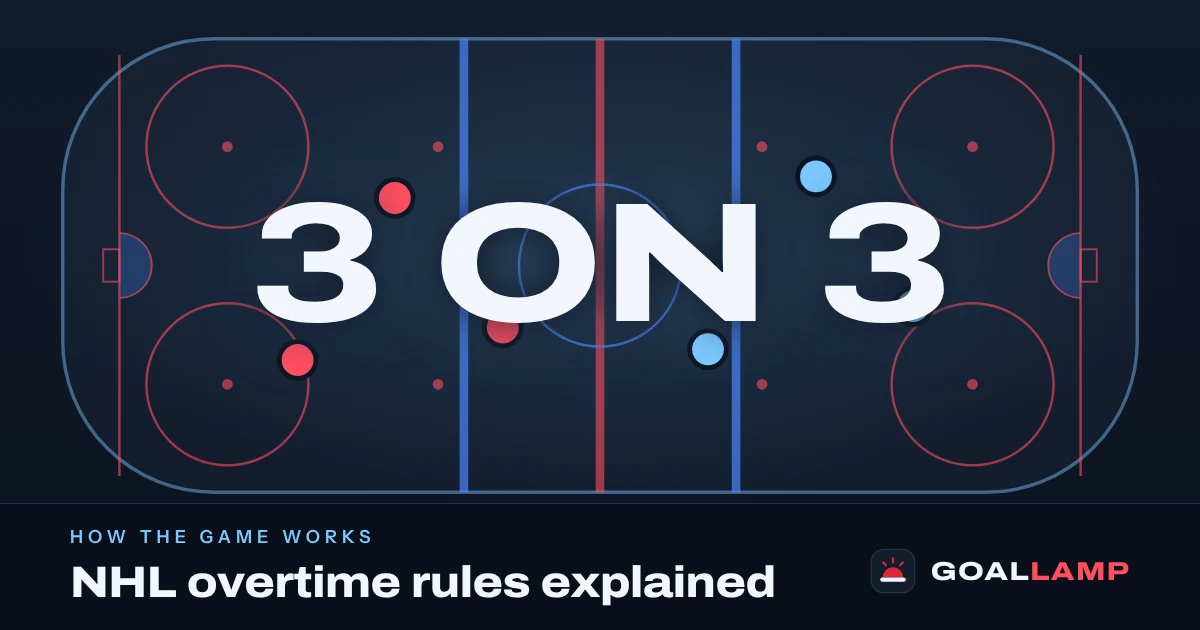
First, the arena crew shovels the snow off the whole ice. Then the teams play one overtime period of five minutes. Each side has three skaters and a goalie. Each team defends the same net it had in the second period. The first goal ends the game.
If nobody scores, the crew shovels the whole ice again. A shootout follows. Each team sends three shooters, one at a time, at the other goalie. A tied shootout goes on with one shooter per team per round. It ends when one team scores and the other does not.
The result also counts in the standings. A win earns two points. A loss in overtime or a shootout still earns one point. A loss in regulation earns zero points.
Playoffs
Playoff games never use 3 on 3 or a shootout. Teams play full 20 minute overtime periods at 5 on 5. The first goal wins, however long that takes. The teams switch ends at the start of each overtime period.
Before playoff overtime, the players get an intermission and the crew floods the ice. NHL Rule 84.5 sets that break at 15 minutes.
Long overtimes get one more cleanup. The crew clears snow at the first whistle after the 10:00 mark. This happens in every playoff overtime period.
Other levels
- Olympics, 2026 men’s event: Group games used five minutes of 3 on 3, then a shootout. Qualification, quarterfinal, semifinal and bronze games used 10 minutes of 3 on 3, then a shootout. The gold medal game used 20 minute periods of 3 on 3 until a goal. The IIHF gives each team five shootout shooters. The NHL uses three.
- NCAA college: The rulebook includes rules for 3 on 3 overtime and a shootout. For 2026 to 2027, women’s games no longer need a shootout. Each conference now picks a tie, more overtime or a shootout. Men’s teams also lost their extra overtime timeout in the regular season.
How the period clock works
The scoreboard clock counts down. Each NHL period starts at 20:00 and runs to 0:00. The NHL rulebook says the clock shows the time left to play. In the last minute, it shows tenths of a second too.
The clock stops at every whistle. A faceoff restarts play and the clock. Players can also change lines on the fly while the clock runs.
TV timeouts add breaks inside each period. The Flames guide lists three TV timeouts per period, each lasting 2 minutes.
Penalty time counts down too. It runs only during live play. A two minute penalty lasts two minutes of game clock. The power play guide covers what happens while a player sits.
When time runs out, a horn sounds on its own. A green light also comes on behind each goal. If the horn fails, the game clock decides whether the period is over. Hockey Canada rules add one detail: a goal cannot count while the green light shows.
NHL event times count up from the start of the period. In the last minute, the NHL also drops the tenths. Take a penalty called with 12.4 seconds left.
- The period runs 20:00 in all.
- The clock shows 12.4 seconds left.
- So 19 minutes and 47.6 seconds have been played.
- The NHL drops the 0.6 and lists the penalty at 19:47.
Fans also ask
Does overtime count as a fourth period?
Yes in the playoffs, where it works like a full extra period. NHL.com calls the first playoff overtime a 20 minute fourth period. A second overtime becomes a fifth 20 minute period. Regular season overtime is one five minute period.
Can an NHL game end in a tie?
No, every NHL game ends with a winner. A regular season shootout keeps going until one team scores and the other does not. Playoff overtime keeps going until someone scores. College hockey is different this season. A women’s NCAA conference can now choose a tie after overtime.
How many periods are in Olympic hockey?
Olympic hockey has three periods of 20 minutes, the same as the NHL. Overtime rules change by round. Group games used five minutes in 2026. The gold medal game used full 20 minute periods. Every overtime at the 2026 men’s event was 3 on 3.
How many halves are in hockey?
The NHL, college hockey and the Olympics have no halves. The youngest players in Canada are the exception. Hockey Canada runs U7 and U9 games as two halves on a running clock. The whole game lasts 60 minutes or less. In U9, the visiting team switches ends and benches after the first half.
How long does one NHL period take in real time?
With the Flames guide numbers, an NHL period takes at least 26 minutes.
- The period has 20 minutes of play.
- Each TV timeout lasts 2 minutes.
- Three TV timeouts add 6 minutes.
- 20 plus 6 gives 26 minutes.
Every other whistle adds more. Three periods of 26 minutes add up to 78 minutes. The two intermissions add 36 more. That puts a full game at 114 scheduled minutes before any other stoppage. The guide to how long a hockey game lasts covers the rest.