A power play in hockey starts when a player goes to the penalty box. His team plays one skater short until the penalty ends. The other team has the extra skater. The most common power play is 5 on 4 for up to two minutes. If the team with more players scores, a two minute power play ends right away. The team that is a player short is on the penalty kill.
Power play situations you will see on TV
At full strength, each team plays five skaters and one goalie. Our guide to how many players are on a hockey team covers the full roster. Every hockey power play below starts from that 5 on 5. Each case follows the NHL rulebook for the 2026 to 2027 season.
A two minute minor (5 on 4)
What you see: A player goes to the penalty box after a foul. The box sits in the middle of the rink, across from the team benches. He stays there for two minutes, and no teammate takes his place.
On the scoreboard: The penalty clock starts at 2:00 and counts down. His team has four skaters, and the other team has five.
How it ends: The player returns when the clock hits zero. It also ends if the team with five skaters scores. That team can also take a penalty of its own. Then play goes to 4 on 4 until one penalty runs out.
A bench minor works the same way. The coach picks any skater but the goalie to serve the two minutes.
A goal scored during a minor
What you see: The team with five skaters scores. The player in the box skates straight back out. The rulebook ends his minor as soon as the goal counts.
On the scoreboard: The goal goes up and the penalty clock clears. Both teams are back to five skaters.
How it ends: One goal ends one minor penalty, and the power play is over. A goal by the shorthanded team frees nobody. That player stays in the box until his time runs out. A goal on a penalty shot does not free him either.
A five minute major
What you see: A player gets a major for a fight or another serious foul. He sits for five minutes, and no teammate replaces him.
On the scoreboard: The penalty clock starts at 5:00.
How it ends: Only the clock ends a major. The NHL rulebook keeps the player in the box even after the other team scores. The team on the power play can score more than once on the same major.
When two fighters both get majors, the teams send out new players right away. The game stays 5 on 5, so no power play starts. Our guide on why fighting is allowed in hockey picks up from there.
A double minor
What you see: Some fouls bring two minors at once, for four minutes in all. High sticking and spearing are two fouls that can draw one.
On the scoreboard: The penalty clock starts at 4:00.
How it ends: The four minutes work as two minors in a row. A power play goal in the first two minutes ends the first minor. The second minor then starts with two full minutes. A goal in the last two minutes ends the penalty for good. With no goal, the player returns when the clock runs out.
Sometimes the team with the edge scores while the referee’s arm is still up. Then the referee wipes out one minor. The player still serves two minutes, and the clock shows 2:00. The announcer still calls it a double minor.
Two penalties at once (5 on 3)
What you see: Two players from one team sit in the box together. Their team has three skaters against five. The two calls can come on the same play or one after the other.
On the scoreboard: Two penalty clocks run for the same team.
How it ends: A goal frees only one player. The NHL rulebook sends back the one with the least time left on his clock. Play then goes to 5 on 4 until the second penalty ends.
A team never drops below three skaters. If a third player takes a penalty, a teammate takes his place on the ice. His penalty time starts only when one of the first two penalties ends.
Matching penalties (4 on 4)
What you see: One player from each team gets a minor at the same whistle. Both players go to the box under the coincidental penalty rule. Neither team replaces its player, so both teams play 4 on 4. The rulebook uses this only when no other penalties are on the clocks.
On the scoreboard: Each team has one penalty clock running from 2:00.
How it ends: A goal at 4 on 4 frees nobody. Neither team is shorthanded, so no penalty ends early. Both players step back on at the first whistle after their time runs out.
The rule changes if one team is already killing a penalty. Then both teams send out new players right away. The power play goes on as before.
A delayed penalty (arm up, extra attacker)
What you see: The referee raises an arm but does not blow the whistle. Play goes on until the team that broke the rule gains control of the puck. The other team can send its goalie to the bench for an extra attacker. The NHL rulebook lets a team take its goalie off and put on another skater.
On the scoreboard: Nothing changes yet. The penalty clock starts only after the whistle.
How it ends: The whistle blows once the fouling team controls the puck. That player goes to the box, and a normal power play starts. If the other team scores first, the referee wipes out a minor. Nobody goes to the box for it. A major still counts after that goal.
A second case comes up during a power play. Say the shorthanded team takes another penalty, and the other team scores before the whistle. The goal frees the first player in the box. The new penalty still counts, so a fresh power play starts.
The penalty kill and shorthanded goals
The team with fewer skaters is on the penalty kill. Its players block shots and clear the puck out of their end. On a minor, a goal against or the clock ends the penalty kill.
The penalty kill also gets a break from the icing rule. A shorthanded team can fire the puck down the ice from its own half. The officials let play go on with no icing call. The team on the power play gets no such break. Our guide to what icing is in hockey explains the full rule.
The shorthanded team can still score. A shorthanded goal counts on the scoreboard like any other goal. The player in the box still stays there. Only a goal against the shorthanded team can end his minor early.
How teams measure a power play in hockey
Power play percentage shows how often a team scores with the extra skater. Say a team gets 40 power plays over a run of games. It scores on 10 of them. To find the rate, divide 10 by 40, which gives 0.25. Move the decimal two places, and that team has a 25 percent power play.
Penalty kill percentage works from the other side. It shows how often a team keeps the puck out while shorthanded. Say the same team is shorthanded 40 times and gives up 8 goals. Take the 8 goals away from 40, and 32 kills are left. Divide 32 by 40, which gives 0.80. That team has an 80 percent penalty kill.
A higher number is better for both stats.
More questions
How long is a power play in hockey?
A power play lasts up to two minutes on a minor penalty. A double minor can stretch it to four minutes, and a major to five. A goal can cut a minor or double minor short. A major always runs the full five minutes.
What happens when the goalie takes a penalty?
The goalie stays in the net, and a teammate serves the time in the box. The NHL rulebook keeps goalies out of the box for a minor. A skater who was on the ice when play stopped goes to the box instead. The team still plays shorthanded.
Can a team pull its goalie on a power play?
Yes, a team on the power play can pull its goalie for an extra skater. The same rule that allows the extra attacker on a delayed penalty applies here. On a 5 on 4, that move makes it 6 on 4. The risk is an empty net when the penalty kill clears the puck.
Do power plays work the same in overtime?
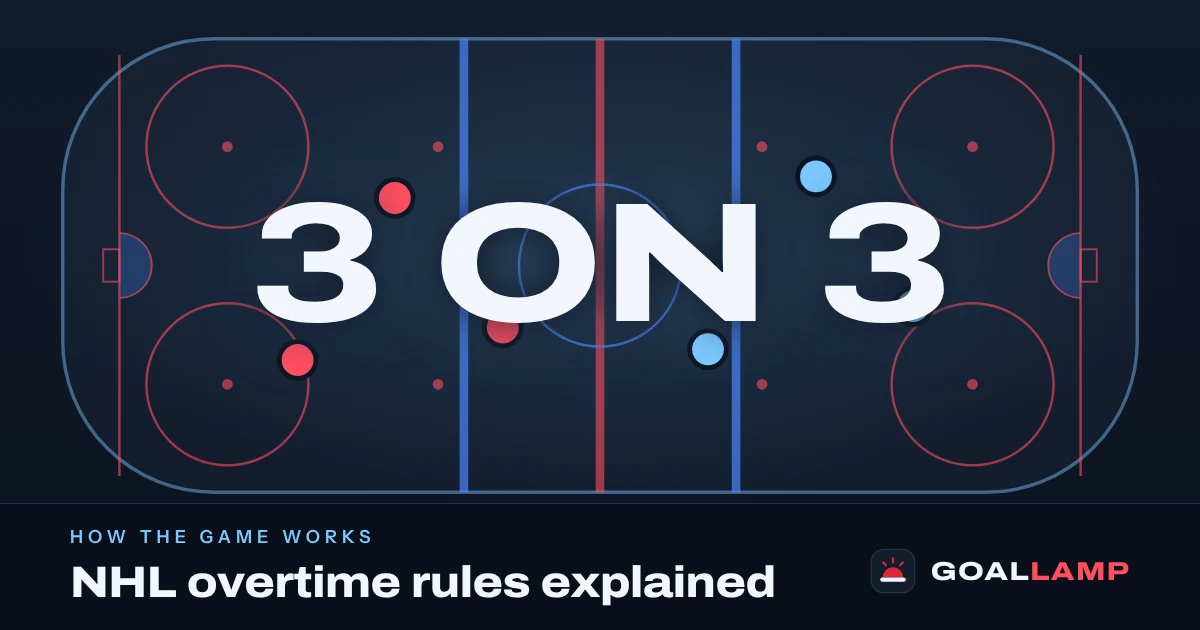
Not always, because the NHL rulebook has extra penalty rules for overtime. One example covers a minor and a major given at the same whistle. This applies in overtime and in the last five minutes of the third period. The team with the major then plays three minutes short right away. Our guide to NHL overtime rules has the rest.
Do international games use the same power play rules?
Yes, a power play in ice hockey works the same way under IIHF rules. The IIHF rulebook for 2026 to 2027 also sets a minor at two minutes. A goal by the other team ends the first minor, as in the NHL. IIHF rules also let a shorthanded team ice the puck without a whistle.