A hockey game has 60 minutes of playing time. The NHL splits it into three periods of 20 minutes each. The night itself runs much longer. The game clock stops at every whistle, and two intermissions sit between the periods. The answer to how long is a hockey game depends on the clock you watch. The first NHL game of the 2026 to 2027 season went to overtime. Its official game sheet shows 2 hours 37 minutes from start to finish.
One NHL game night, from 7 pm puck drop to the final horn
This walk through uses the real opener of the 2026 to 2027 season. Florida beat Carolina 1 to 0 in overtime on September 29, 2026. The game sheet lists a 5:20 pm start and a 7:57 pm end, Eastern time. Below, the same game starts at 7 pm instead.
- 7:00 pm, game clock at 20:00. The referee drops the puck. The scoreboard clock counts down, because the NHL rulebook says it must show the time left to play.
- First period, clock running. The clock stops at each whistle. During every commercial time out, the ice crew clears snow from the crease areas and in front of the benches.
- Clock under 1:00. The clock starts showing tenths of a second for the last minute of the period.
- Clock at 0:00, 20 minutes played. The horn ends the first period. The first intermission begins, and the crew resurfaces the ice. NHL Rule 77.2 sets each break at 18 minutes.
- Second period, clock back at 20:00. The same routine repeats. When the clock hits 0:00, the teams have played 40 minutes. The second 18 minute intermission and another resurfacing follow.
- Third period, clock at 20:00. Florida and Carolina finished it tied 0 to 0. The teams had now played 60 minutes.
- Before overtime. Arena crews shovel the entire ice surface, as the rulebook requires for a tied regular season game. Overtime should start about 2 minutes after regulation ends.
- Overtime, clock at 5:00. Three skaters per side play a five minute overtime, and the next goal wins.
- Overtime clock at 0:05. Forsling scores for Florida 4:55 into overtime. The game clock has run 64 minutes and 55 seconds in all.
- 9:37 pm, final horn. The night ends 2 hours 37 minutes after puck drop.
The real game started at 5:20 pm and ended at 7:57 pm. That is 2 hours 37 minutes. Add 2 hours 37 minutes to a 7:00 pm start. The final horn sounds at 9:37 pm.
The game clock ran for 64 minutes and 55 seconds. Two hours and 37 minutes come to 157 minutes. Take the clock time away from 157 minutes. About 92 minutes are left, and the clock stood still for all of them.
The two intermissions explain a big part of that. Each one lasts 18 minutes, so together they take 36 minutes. Take 36 from 92, and about 56 minutes are left. Whistles, commercial time outs, reviews and the break before overtime fill the rest.
The intermission clock starts once the last official leaves the ice, under NHL Rule 34.2. The NHL game sheet lists only the start and end of each game. That is why the periods above carry no wall clock times.
What stops the clock and adds time
Hockey uses stop time. The game clock runs only while the puck is in play. The IIHF rule book starts the clock at the faceoff. It stops the clock at each whistle. The NHL opener shows the same pattern. Its 157 minute night held under 65 minutes of play.
These things stop play or add minutes in an NHL game.
- Whistles. The referee stops play for calls like offside and icing in hockey, and a faceoff restarts the clock.
- Commercial time outs. A red light near the timekeeper’s bench stays on during each one. An NHL commercial coordinator controls the light, and play resumes when it goes off.
- Penalties. NHL Rule 16.1 sends a player off for two minutes on a minor penalty. Hockey Canada rules say penalties run in actual playing time, so a whistle pauses them too. Our guide to how a power play works covers what happens next.
- Injuries. Under NHL Rule 8.1, the referee can wait to stop play until the injured player’s team has control of the puck.
- Video reviews. The NHL video rulebook lists review cases such as a puck crossing the goal line. Each review holds up the game.
- Goalie changes. NHL Rule 8.2 gives a substitute goalie no warm up in regular season or playoff games. So a goalie swap does not add a warm up.
When games run long
A tie after 60 minutes adds time to the night. How much time depends on the part of the season.
Regular season overtime and the shootout
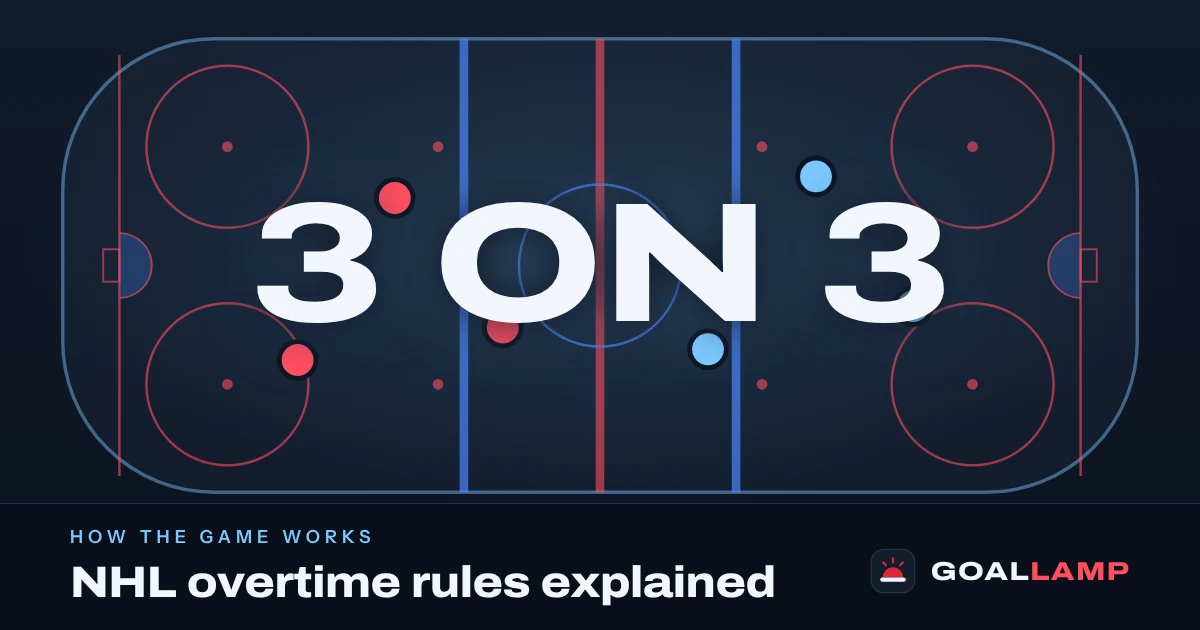
Crews shovel the whole ice before overtime. Then the teams play up to five minutes of 3 on 3. The first goal ends the game. If nobody scores, crews shovel the ice again and a shootout follows. Each team sends three shooters first. More rounds follow, one pair of shooters at a time, until one team wins. So a regular season NHL game never ends in a tie. Our guide to NHL overtime rules covers the details, including standings points.
Playoff overtime keeps going until a goal
Playoff games never use a shootout. After 60 minutes, the teams take a 15 minute intermission while the ice is resurfaced. Then they play a full 20 minute period, 5 on 5. Another break and another period follow until someone scores. Crews also clear snow during each overtime period. They do it at the first stoppage at or after 10:00.
A June 6, 2026 playoff game shows how long that can take. Vegas beat Carolina 5 to 4 at home. Theodore scored the winner 5:38 into the second overtime. The game sheet lists a 5:23 pm start and a 9:24 pm end, Pacific time. That is 4 hours 1 minute.
Here is how the clock time adds up for that game. Regulation took 60 minutes. The first overtime ran the full 20 minutes. The second overtime lasted 5 minutes and 38 seconds. Together they make 85 minutes and 38 seconds of play.
The longest NHL game
NHL.com lists a game from March 24, 1936 as the longest game in NHL history. Detroit beat the Montreal Maroons 1 to 0 at the Forum. Mud Bruneteau scored at 16:30 of the sixth overtime. The goal came at 2:25 the next morning. Regulation was 60 minutes. The overtime periods added 116 minutes and 30 seconds. The game had 176 minutes and 30 seconds of play in all.
How long is a hockey game outside the NHL?
College and international games also have 60 minutes of play. Their breaks and overtime rules differ from the NHL.
This table compares game length rules in the NHL, college, international and youth hockey.
| Level | Playing time | Breaks | If tied after 60 minutes |
|---|---|---|---|
| NHL | Three 20 minute periods | Two 18 minute intermissions; 15 minutes before playoff overtime | Regular season: up to 5 minutes of 3 on 3, then a shootout. Playoffs: 20 minute periods until a goal |
| NCAA college | 60 minutes of play | 12 or 15 minute intermissions (2022 rule) | Regular season: 3 on 3 overtime, then a tie, more overtime or a shootout, by conference policy. Playoffs: 20 minute sudden victory periods |
| IIHF international | Three 20 minute periods | 15 minutes, unless the IIHF sets another length | Round robin games: 3 minute break, then up to 5 minutes of sudden victory overtime. Other games can use other formats |
| Youth (USA Hockey, Hockey Canada) | Varies by age group and league | Varies by league | Varies by league |
College rules changed in 2026. NCAA women’s games no longer require a shootout after overtime. The NCAA also dropped the extra timeout in regular season overtime. Each college team gets one timeout of one minute during regulation. A 2022 NCAA rules change set intermissions at 12 or 15 minutes. It also removed the 18 minute option.
Youth game length varies by age group and league. Ask the league or check the schedule before you plan the evening.
Planning tips for fans going to a game
- Expect puck drop after the ticket time. NHL.com listed the 2026 to 2027 opener for 5 pm Eastern. The game sheet shows the start at 5:20 pm.
- Count from the listed time. From 5:00 pm to the 7:57 pm final horn is 2 hours 57 minutes. That opener went to overtime, so plan for about three hours in your seat on a night like that one.
- Come early for warmups. The NHL rulebook ties the visiting lineup deadline to the end of warmups and to 20 minutes before faceoff. So players finish warming up not long before puck drop.
- Stay if the game is tied. A tie after 60 minutes brings up to five minutes of 3 on 3 and maybe a shootout.
- Clear the whole evening for playoff games. The June 2026 double overtime game ran 4 hours 1 minute.
- Check the start time for each game. Each team plays 84 games this season. The NHL schedule includes Monday matinee games and games set for European prime time.
- Convert the time zone. NHL.com gave opening night start times in Eastern time. Fans in Canada and the US outside that zone should convert to local time.
- Leave room for the trip. Give yourself extra time for parking and security lines.
Your questions answered
How long are hockey periods?
NHL periods last 20 minutes of game clock each. Three periods add up to 60 minutes of play. Each period takes longer on your watch, because the clock stops at every whistle. Our guide on how many periods are in hockey covers the full game structure.
How long is the average NHL game?
The length changes every night, so one average does not fit every NHL game. Each official game sheet lists that game’s own start and end. The 2026 to 2027 opener ran 2 hours 37 minutes with overtime. A June 2026 double overtime playoff game ran 4 hours 1 minute.
Is there a break before overtime?
Yes in the playoffs, where teams get a 15 minute intermission before overtime. In the regular season, crews shovel the whole ice before the five minute overtime. That short break should last about 2 minutes, under NHL Rule 84.1.
Can an NHL game end in a tie?
No, an NHL game cannot end in a tie. A shootout decides any regular season game still tied after overtime. Playoff games keep adding 20 minute periods until someone scores. Some college games can still end in a tie when the conference allows it.
How long is an international ice hockey game?
An international ice hockey game has three 20 minute periods under IIHF rules. The IIHF rule book sets 15 minute intermissions unless the IIHF picks another length. A tied round robin game gets a three minute break. Up to five minutes of sudden victory overtime follow.