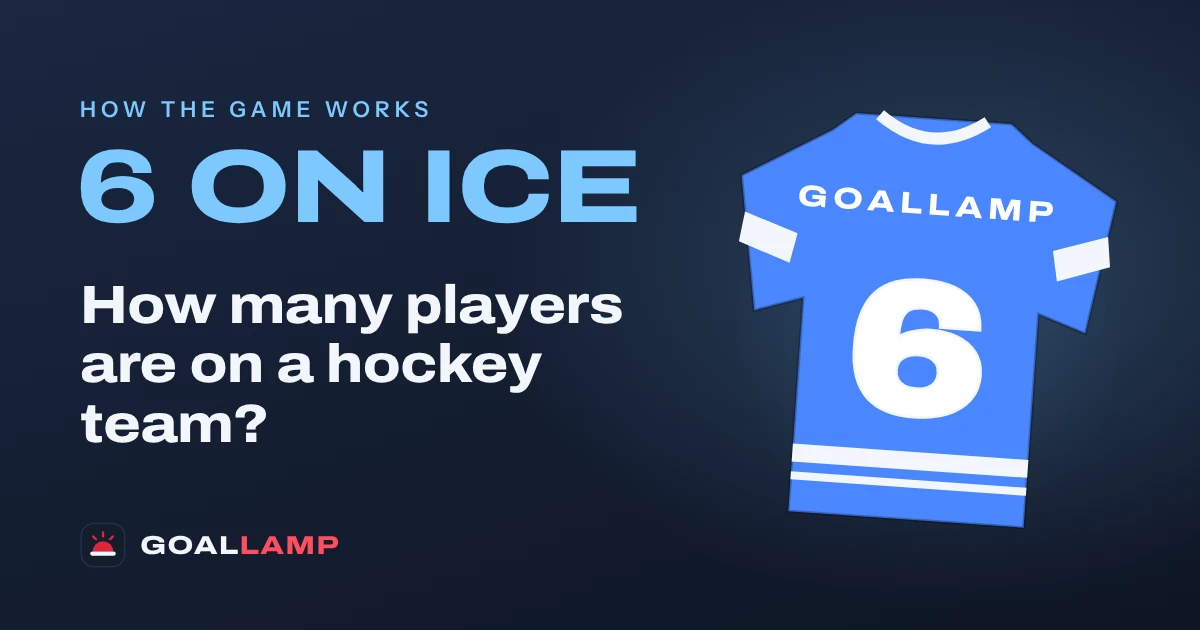
Each hockey team has 6 players on the ice at a time. Five are skaters, and one is the goalie. An NHL team dresses 20 players for each game, with 18 skaters and 2 goalies. The 2026 to 2027 NHL rulebook sets that number in Rule 5.1. The NHL also lets a team carry up to 23 players on its roster. Three numbers answer how many players on a hockey team: 6, 20 and 23.
The six on the ice
The six players fill four kinds of hockey positions. Three forwards play up front, and two defensemen play behind them. The goalie stays in the net and faces the shots.
Center
The center plays in the middle of the ice, between the two wingers. Centers usually take the faceoffs. A center also skates back to help the defensemen in his own end.
Wingers
Each forward line has a left wing and a right wing. Wingers skate up the sides of the rink and look for shots. Back in their own end, they cover the other team’s defensemen near the blue line.
Defensemen
Two defensemen play behind the forwards, one on each side. They try to stop the other team’s rushes and keep shots away from their goalie. On offense, they often wait near the blue line to keep the puck in.
Goalie
The goalie guards the net and stops shots. Rule 5.3 allows each team one goalie on the ice at a time. Every NHL team dresses two goalies for a game, a starter and a backup.
How an NHL game day lineup is built
Rule 5.1 sets the NHL game day lineup at 20 players. That group holds 18 skaters and 2 goalies. NHL.com lists its projected lineups for the 2026 to 2027 season in this shape.
- Forward line 1: left wing, center, right wing
- Forward line 2: left wing, center, right wing
- Forward line 3: left wing, center, right wing
- Forward line 4: left wing, center, right wing
- Defense pair 1: left defense, right defense
- Defense pair 2: left defense, right defense
- Defense pair 3: left defense, right defense
- Goalies: one starter and one backup
Each forward line has 3 players. Four lines add up to 12 forwards. Each defense pair has 2 players, so three pairs add up to 6 defensemen. Then 12 forwards plus 6 defensemen make 18 skaters. Add the 2 goalies, and the lineup reaches 20.
Coaches send these lines and pairs onto the ice in turns all game. A coach can also change the mix of skaters. On October 16, 2026, NHL.com said Colorado expected to dress 11 forwards and seven defensemen. That would make five games with that mix for the Avalanche this season. Eleven forwards plus seven defensemen still make 18 skaters, so the total stays at 20.
Rule 5.1 sets a deadline for the lineup list. The visiting coach has five minutes after the warmup to send it in. Once the game starts, no one can change that list. The same 20 player limit applies to all 32 NHL teams.
How many players are on an NHL team?
An NHL team can carry up to 23 players on its roster. The NHL Hockey Operations Guidelines set that cap. It runs from the first day of the regular season through the trade deadline. Each club must also keep at least 20 players, with 18 skaters and two goalies.
A full roster holds more players than a game day lineup. Twenty of the 23 players dress for a game. The other 3 sit out that night.
Injured players can move to injured reserve. Players on injured reserve do not count toward the 23 limit. The team can add another player to its roster in that spot. A player on injured reserve must sit out at least seven days. He can still practice and travel with the team.
Every NHL team must also have an emergency backup goalie this season. The league approves each one, and he works for the team. He cannot have played in an NHL game under a standard player contract. He also cannot have played pro hockey in the past three seasons. Each emergency goalie wears number 00.
When a team has fewer than six on the ice
Penalties
A player who takes a penalty sits in the penalty box. His team plays one skater short until the penalty ends. One penalty leaves 4 skaters against 5. Two penalties at once leave 3 skaters against 5. The other team gets a power play for that time.
If the team with more skaters scores, Rule 16.2 ends the first minor penalty early. Sometimes one player from each team gets a minor penalty at the same stoppage. Rule 19.1 then has both teams play four skaters against four.
NHL Rule 26.1 keeps every team at three skaters or more. A third penalty waits until one of the first two ends. The IIHF and college rulebooks work the same way.
Overtime
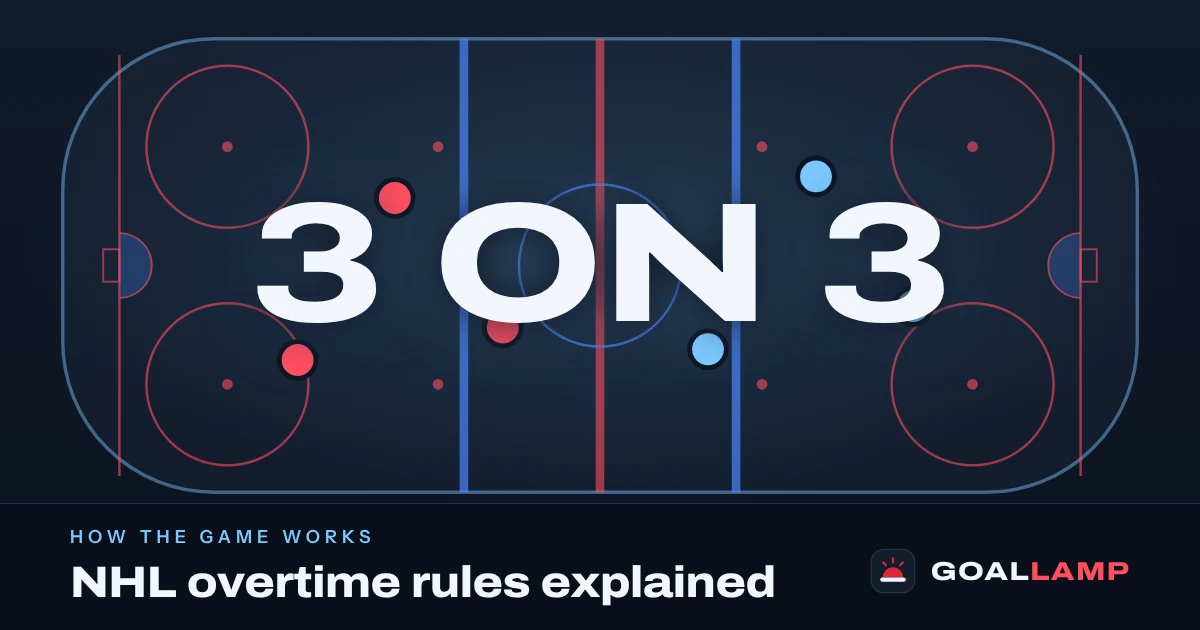
NHL regular season overtime lasts five minutes. Each team plays three skaters and a goalie, according to NHL.com. If nobody scores, a shootout decides the game. Penalties still count in overtime. Rule 84.3 makes a single penalty 4 on 3. On October 15, 2026, the Senators and the Islanders each had an overtime power play. Neither team scored on it.
Playoff overtime uses 20 minute periods with five skaters a side. Our guide to NHL overtime rules covers the rest of the format.
Pulling the goalie
A coach can pull the goalie for an extra skater. Rule 5.3 allows the swap. The extra skater gets none of the goalie’s special rights. The team then has six skaters and an empty net.
On October 15, 2026, Nashville pulled goalie Juuse Saros for an extra attacker. Steven Stamkos tied it 2 to 2 with one second left in the third. San Jose still won 3 to 2 in a shootout.
Players on the ice at other levels
This table compares on ice counts and game day rosters in three current rulebooks.
| Level | On the ice per team | Game day roster | Rule |
|---|---|---|---|
| NHL | 6: 5 skaters and 1 goalie | 20: 18 skaters and 2 goalies | NHL Rule 5.1 |
| NCAA men and women | 6 at most | 22: 19 skaters and 3 goalies | NCAA Rule 5.1 |
| IIHF events | 6: 5 skaters and 1 goalie | 22: 20 skaters and 2 goalies | IIHF Rule 5 |
College teams can list a third goalie. Their game roster holds 22 players, which is two more than an NHL lineup. The IIHF also allows 22 players, but with 20 skaters and 2 goalies. The NCAA rulebook covers both men’s and women’s college hockey.
The 2026 Olympic final also went past regulation. The United States beat Canada 2 to 1. The winning goal came 1:41 into overtime, during 3 on 3 play.
Youth rules change by age group and by league. Parents can check the USA Hockey or Hockey Canada rulebook for their child’s level.
Quick questions
How many players sit on the bench in an NHL game?
Fourteen players wait on each bench when both teams are at full strength. Each team dresses 20 and puts 6 on the ice. Twenty minus 6 leaves 14, and that count includes the backup goalie.
How many players dress for one NHL game in total?
Forty players dress for each NHL game. Each team dresses 20, and 20 plus 20 makes 40. At full strength, 12 of them are on the ice at once.
What happens if both goalies get hurt?
The team can dress and play any eligible goalie under Rule 5.3. This season each team has an emergency backup goalie for that case. He steps in when both dressed goalies cannot play.
Do teams dress more players in the playoffs?
No, playoff teams still dress 20 players. Under the new labor deal, those 20 players also count against the playoff salary cap.