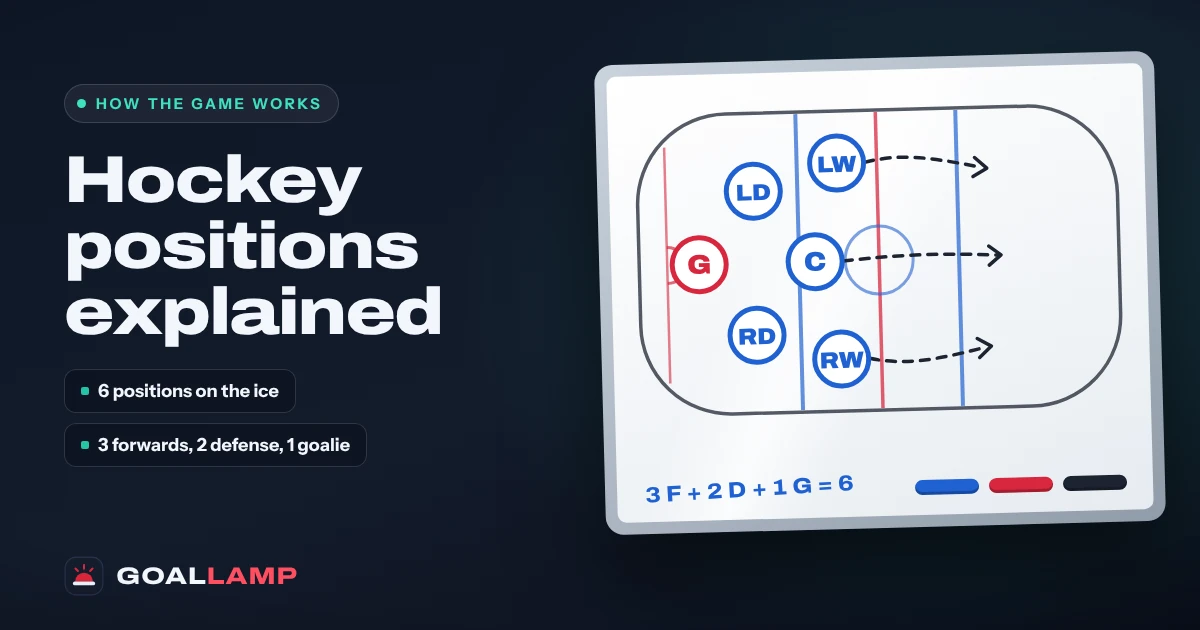
A hockey team plays six positions on the ice: center, left wing, right wing, left defense, right defense and goalie. The forwards attack. The defensemen guard their net, and the goalie stops shots.
Those six hockey positions split into three groups: 3 forwards, 2 defensemen and 1 goalie. Each team has the same six spots at full strength.
The 6 hockey positions at a glance
This table shows each position, how NHL.com labels it and the main job.
| Position | Label | Group | Main job | Position award |
|---|---|---|---|---|
| Center | C | Forward | Takes most faceoffs and helps in both ends | Selke Trophy, for the best defensive forward |
| Left wing | LW | Forward | Screens the goalie and battles in the corners | Selke Trophy, for the best defensive forward |
| Right wing | RW | Forward | Screens the goalie and battles in the corners | Selke Trophy, for the best defensive forward |
| Left defense | D | Defense | Stops rushes and starts the attack | Norris Trophy, for the best defenseman |
| Right defense | D | Defense | Stops rushes and starts the attack | Norris Trophy, for the best defenseman |
| Goalie | G | Goaltender | Stops shots and moves loose pucks | Vezina Trophy, for the best goalie |
What the rulebooks call each position
The NHL rulebook does not name a center, a winger or a defenseman. Rule 5.1 builds a team from skaters and goalkeepers only.
The IIHF rulebook works the same way. College hockey is different. NCAA Rule 5.1 names all six spots, from goalkeeper to left wing.
In the NHL, coaches assign most positions in hockey. The rulebook only sets out the goalkeeper role.
Lines and pairs
Centers and wingers usually play together in a line of three. Most NHL teams roll three or four lines, the NHL says.
Defensemen play in left and right pairs. Our guide to players on a hockey team covers the full lineup of 20.
Center
The center plays in the middle of the ice, between the two wingers. NHL.com says centers are involved with most faceoffs.
Centers often lead the breakout from their own end. They also help protect their net when the other team has the puck.
Faceoffs by the numbers
Montreal captain Nick Suzuki shows how many faceoffs a top center takes. These steps use his 2025 to 2026 numbers from NHL.com:
- Suzuki took 1,449 faceoffs, sixth most in the NHL.
- That was 32.2% of all Montreal faceoffs.
- Dividing 1,449 by 0.322 gives about 4,500 Montreal faceoffs.
- So one center took about one in every three draws.
When the center gets waved out
The linesman can throw a center out of a faceoff for a violation. A teammate then steps in to take the draw.
After an icing, the NHL gives a warning first instead. Since 2024 to 2025, that warning covers the attacking center too.
In IIHF play, goalies never take faceoffs. Rule 76.1 says a goalkeeper may not take part.
The Selke Trophy
The Selke Trophy goes to the forward who plays the best defense. Suzuki won it in 2026, with 151 of 198 first place votes.
He also wears the C for Montreal. A center can be a team’s captain, and so can any other skater.
Left wing and right wing
The left wing and right wing play on each side of the center. NHL.com says wingers screen the goalie and battle in the corners.
Wingers are also often among a team’s top shot blockers. NHL.com says the third and fourth lines often hold the better defenders.
Left wing and right wing by shooting hand
Wingers were once placed by the hand they shoot with. NHL.com says a left handed shooter on the right wing gets a better shooting angle.
The best wingers in 2025 to 2026
Each NHL All Star Team picks one left wing and one right wing. These wingers made the 2025 to 2026 teams:
- First Team right wing Nikita Kucherov, Tampa Bay: 44 goals, 130 points
- First Team left wing Jason Robertson, Dallas: 45 goals, 96 points
- Second Team right wing David Pastrnak, Boston: 29 goals, 100 points
- Second Team left wing Cole Caufield, Montreal: 51 goals, 88 points
Kucherov also won the 2026 Hart Trophy as the most valuable player.
Left defense and right defense
Two defensemen play behind the forwards, one on each side. NHL.com says the left and right defense work in pairs, much like a forward line.
When one defenseman joins the attack, the partner stays back. Defensemen can also start the attack from behind their own net.
The power play quarterback
NHL.com says defensemen are usually the power play quarterback for their team.
Our guide to the power play shows how those extra skater chances work.
Why defensemen play the most minutes
Top defensemen stay on the ice longer than top forwards. NHL.com’s 2025 to 2026 numbers show the gap:
- Defenseman Zach Werenski, Columbus: 26:37 a game, second in the NHL
- Defenseman Cale Makar, Colorado: 24:51 a game
- Center Connor McDavid, Edmonton: 22:59 a game
- Right wing Nikita Kucherov, Tampa Bay: 20:20 a game
Werenski played 3 minutes and 38 seconds more a game than McDavid.
The Norris Trophy
The Norris Trophy goes to the defense player with the best all around game. Werenski won it in 2026, the first Blue Jackets player to do it.
He scored 22 goals and 81 points in 75 games. Makar and Rasmus Dahlin were the other two finalists.
Goalie
The goalie guards the net and stops shots. NHL.com calls goaltending the hardest hockey position in elite play.
A goalie can also pass a loose puck or stop it behind the net. NHL.com says the goalie needs to be a communicator.
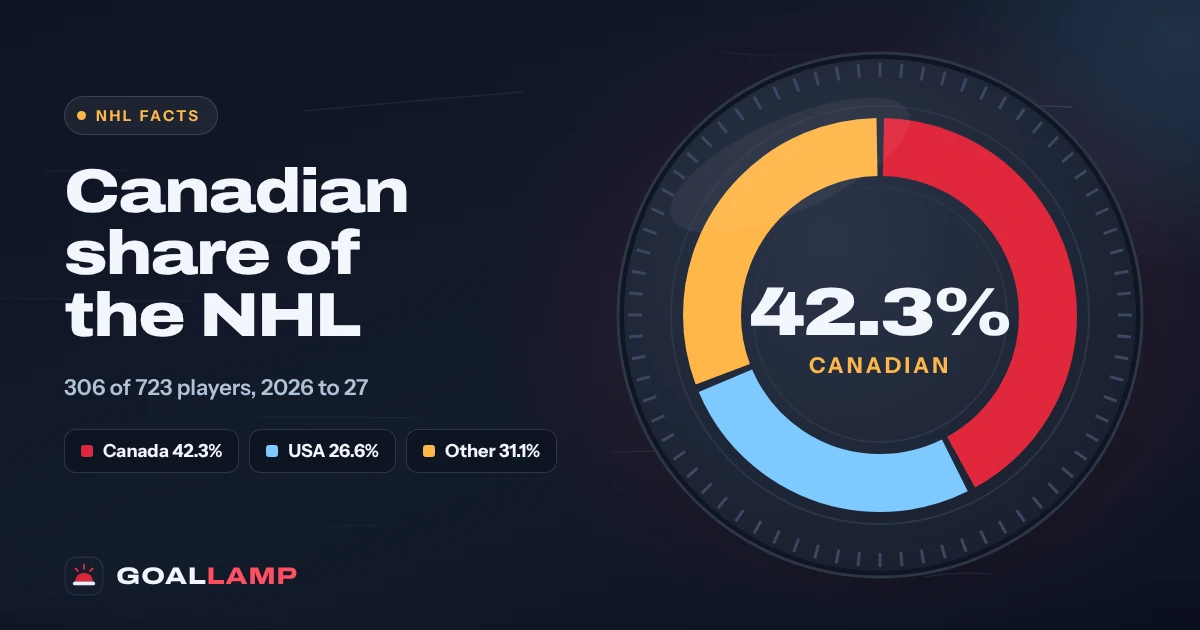
On the NHL roster pages, 23 of 74 goalies were born in Canada, a 31.1% share. The Canadian share of NHL players guide compares goalies with skaters.
Rules that only apply to goalies
Goalies have several rules of their own. These come from the NHL rulebook:
- Rule 5.3 allows one goalie on the ice per team at a time.
- The backup must sit fully dressed and ready to play.
- Rule 6.1 bars a goalie from being captain or alternate captain.
- Rule 16.1 keeps goalies out of the box for minor penalties.
- A goalie’s stick blade can be 3.5 inches wide, under Rule 10.2.
- A skater’s blade must be 2 to 3 inches wide, under Rule 10.1.
The trapezoid behind the net
NHL Rule 1.8 marks a trapezoid behind each goal line. The IIHF marks a similar area. Its Rule 27.7 gives a goalie a minor for playing the puck outside it.
The rulebook distances make the shape easy to picture:
- The lines start 8 feet from each post, and the posts are 6 feet apart.
- So 8 plus 6 plus 8 makes about 22 feet at the goal line.
- At the end boards, each line sits 11 feet from its post.
- So 11 plus 6 plus 11 makes about 28 feet at the boards.
Can goalies score?
Yes, but it is rare. NHL.com counts 21 goals by 18 goalies in NHL history.
The latest came on 1 October 2026. Rangers goalie Igor Shesterkin shot the puck into an empty net. It was the first goalie goal in Rangers history.
Goalie awards
The Vezina Trophy goes to the best goalie, and the NHL general managers vote. Andrei Vasilevskiy won it in 2026 for Tampa Bay, his second Vezina.
Goalies can win the Hart Trophy too. Connor Hellebuyck won it in 2025, and Carey Price won it in 2015.
Can this position do it?
Pick a position and an action. See the answer and the rule behind it.
Where you see hockey positions on rosters
NHL.com pages show positions in a few different ways. Fans meet these labels during the season:
- All Star tables use the codes C, LW, RW, D and G.
- Team player pages say “Center”, “Right Wing”, “Defenseman” or “Goaltender”.
- Player pages also show the shooting hand, such as “Shoots: Left”.
- Projected lineups list lines of three and pairs of two, with extras under “Scratched”.
C for center, or C for captain?
The letter C has two jobs in hockey. On a roster table, C marks a center. On a sweater, Rule 6.1 makes the C the team captain’s letter.
The Devils’ 2026 to 2027 roster shows “Nico Hischier (C)”. Those brackets mark him as the captain.
How many of each position teams carry
Each club picks its own mix of positions. This table shows three 2026 to 2027 opening rosters from NHL.com.
| Team | Forwards | Defensemen | Goalies | Total |
|---|---|---|---|---|
| Tampa Bay Lightning | 15 | 8 | 2 | 25, with 2 forwards injured |
| Columbus Blue Jackets | 13 | 6 | 2 | 21 |
| New Jersey Devils | 14 | 6 | 3 | 23 |
For the oldest player at each position, see the oldest NHL player guide.
Positions at the Olympics
The IIHF hands out awards by position group. At the 2026 Olympics, it named a best goalie, defender and forward.
Connor McDavid won the men’s MVP and best forward awards. On the women’s side, defender Caroline Harvey of the United States was named MVP.
Which position should a beginner play?
USA Hockey and Hockey Canada both say young players should try all positions in hockey. Full time goalies come later.
This table shows what each group recommends by age.
| Age group | USA Hockey | Hockey Canada |
|---|---|---|
| 8U or U9 | Rotate every player through goal, with no full time goalies | Rotate all players through goal |
| 10U or U11 | Players still play all three positions | All players play all positions, and full time goalies are allowed |
| 12U | Goalies start to specialize and rotate full periods | Not listed |
When a child can become a full time goalie
Hockey Canada allows full time goalies at U11, with goalies splitting games close to 50/50. On USA Hockey’s youth site, goalie coach Phil Osaer says 12 or 13 and up.
Hockey Canada’s U11 plan rotates players through LW, C, RW, RD and LD. Each player tries all five spots over five games.
Hockey Canada also says to pick players on skill, not on the position they like. Hockey Canada lists the full U11 guidance.
Good to know
What are the 6 hockey positions?
There are six hockey positions: center, left wing, right wing, left defense, right defense and goalie. Three are forwards, two are defensemen and one is the goalie.
What is the hardest position in hockey?
NHL.com calls goaltending the hardest position in elite play. Goalies also follow several rules that skaters do not.
Can a goalie be the team captain?
No. NHL Rule 6.1 bars goalies from being captain or alternate captain. The IIHF and NCAA rulebooks say the same.
Do defensemen score goals?
Yes, and top defensemen score often. Werenski scored 22 goals in 2025 to 2026, and Makar scored 20.
What does D mean on a hockey roster?
D marks a defenseman. NHL.com does not split defensemen into left and right on its All Star tables.
Can a player change positions?
Yes. The NHL rulebook names only skaters and goalies, so a coach can move any skater. Young players in Canada rotate through every skating position.
Take your shot
A goalie trips an attacker and gets a minor penalty. Who sits in the penalty box for him?
Pick one to take your shot.
Checked against NHL Rules 5, 6 and 16
NHL.com guide to hockey positions
Hockey Canada U11 coaching guidance
Checked October 2026