The puck line is hockey’s version of a point spread. It is usually set at 1.5 goals. The favorite gets minus 1.5 and must win by 2 or more goals to cover. The underdog gets plus 1.5. It covers by winning the game or by losing by just 1 goal.
The extra half goal stops any tie on the line. Teams score whole goals, so no game can finish 1.5 goals apart. One side of the puck line covers in every game. Next to each side, a small odds number shows how likely that result looks.
How to read a puck line
This sample shows one game the way an app or TV graphic might list it.
| Team | Puck line | Odds number |
|---|---|---|
| Team A | -1.5 | +140 |
| Team B | +1.5 | -165 |
Team A has the minus sign on its 1.5, so Team A is the favorite. Team A must win by at least 2 goals for its side to cover.
Team B has the plus sign, so Team B is the underdog. Team B covers with any win at all, by any score. It also covers with a loss by exactly 1 goal.
The odds number is separate from the 1.5. The goal number usually stays at 1.5 from game to game. The odds number shifts with each matchup.
A minus odds number marks the result the line sees as more likely. A plus odds number marks the less likely result.
In this sample, Team A is the favorite to win the game. Even so, its minus 1.5 side carries a plus number. Winning by 2 goals is a harder task than winning by 1. You can try a different line in our puck line decoder.
Final scores and what each side of the line gets
This table runs the sample line through eight final scores.
| Final score | How it ended | Gap for Team A | Team A minus 1.5 | Team B plus 1.5 |
|---|---|---|---|---|
| Team A 4, Team B 1 | Regulation | Won by 3 | Covers | Falls short |
| Team A 3, Team B 2 | Regulation | Won by 1 | Falls short | Covers |
| Team A 3, Team B 2 | Overtime goal | Won by 1 | Falls short | Covers |
| Team A 3, Team B 2 | Shootout after a 2 to 2 tie | Won by 1 | Falls short | Covers |
| Team A 2, Team B 3 | Regulation | Lost by 1 | Falls short | Covers |
| Team A 1, Team B 4 | Regulation | Lost by 3 | Falls short | Covers |
| Team A 4, Team B 2 | Team A scored into an empty net late, up 3 to 2 | Won by 2 | Covers | Falls short |
| Team A 4, Team B 3 | Team B scored late with its goalie pulled, down 4 to 2 | Won by 1 | Falls short | Covers |
Team A covers in only two of the eight rows. Both of those wins came by 2 goals or more.
The overtime and shootout rows land the same as a 1 goal win in regulation. The two late goal rows show one goal flipping the result in either direction.
How American odds turn into an implied chance
Simple math turns each odds number into a percent chance. Both examples below use the sample line from above.
Worked example with a minus number
Team B at plus 1.5 carries minus 165 in the sample.
First, drop the minus sign, which leaves the number 165.
Next, add 100 to that number, and 165 plus 100 makes 265.
Then divide 165 by 265, and the answer comes to about 0.623.
Move the decimal two places to the right to get about 62.3%.
The line gives Team B about a 62.3% chance to cover.
Worked example with a plus number
Team A at minus 1.5 carries plus 140 in the sample.
With a plus number, start by adding 100 to it, which makes 240.
Next, divide 100 by 240, and the answer comes to about 0.417.
Move the decimal two places to the right to get about 41.7%.
The line gives Team A about a 41.7% chance to win by 2 or more.
What the two chances add up to
Team B’s 62.3% plus Team A’s 41.7% makes 104%. Odds makers build a small edge into each line. That edge pushes the pair a little over 100%.
The same math works on the moneyline. Say the sample game lists Team A at minus 200 on the moneyline.
Drop the minus sign to get 200, then add 100 to make 300.
Divide 200 by 300, and the answer comes to about 0.667.
The moneyline gives Team A about a 66.7% chance to win the game.
Put the two lines side by side and they tell one story. Team A wins about 67 of every 100 games like this one. It wins by 2 or more in only about 42 of them.
Why empty net goals matter so much on the puck line
The trailing coach often swaps the goalie for an extra skater late in close games. The NHL rulebook allows the swap. Rule 5.3 says the goalkeeper “may be removed and another skater substituted”.
Coaches now pull goalies earlier than they used to. An NHL.com analytics column in April 2022 said goalies are being pulled “earlier and earlier”. In October 2018, Dallas Stars coach Jim Montgomery pulled goalie Ben Bishop with 7:48 left. His team trailed the Senators 3 to 1 at the time, NHL.com reported. A 2 goal lead can shrink to 1 in those final minutes.
An empty net can push the puck line either way.
- Team A leads 3 to 2, and Team B pulls its goalie. Team A shoots into the empty net. The final reads 4 to 2, and minus 1.5 now covers.
- Team A leads 4 to 2, and Team B pulls its goalie. Team B scores with the extra skater. The final reads 4 to 3, and plus 1.5 now covers.
- Team A leads 3 to 2, and Team B pulls its goalie. Team B ties the game 3 to 3. Overtime follows, and the game can only end 1 goal apart.
An empty net goal counts in the final score like any other goal. One late goal can move the puck line from one side to the other.
Overtime and shootout results on the puck line
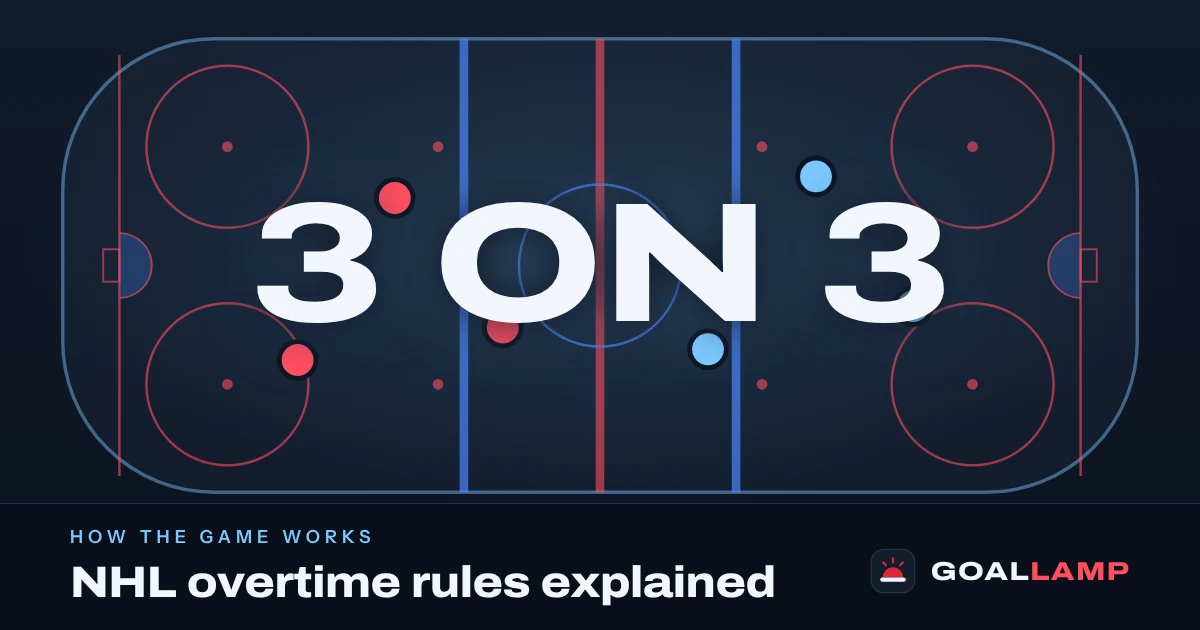
A game tied after regulation always ends with a 1 goal margin. In overtime, the first goal ends the game, so the winner leads by exactly 1. Our guide to NHL overtime rules covers the full format.
If overtime ends with no goal, a regular season game moves to a shootout. Rule 84.4 sets how that game shows up in the final score. The NHL quotes the rule word for word. The final score “will give the winning team one more goal than its opponent”. That holds no matter how many shootout goals each team scores.
Say the game is tied 2 to 2 after overtime. Team A scores twice in the shootout and Team B scores once. The final score reads Team A 3, Team B 2. Team B at plus 1.5 covers, since it lost by only 1 goal.
The Stanley Cup Playoffs have no shootouts. Tied playoff games go to a 20 minute fourth period, where the first goal wins. That final also ends 1 goal apart.
On the main NHL puck line, every overtime or shootout game goes to plus 1.5. Some apps also list a regulation or 60 minute line. That line looks only at the three periods of regulation and ignores overtime. Check the label on a line before reading the final score against it.
Puck line vs moneyline vs total
This table checks three common lines against one final score.
| Line | What it asks | Sample line | Team A wins 3 to 2 in overtime |
|---|---|---|---|
| Moneyline | Which team wins the game | Team A -200, Team B +170 | Team A’s side comes out ahead |
| Puck line | Does the favorite win by 2 or more | Team A -1.5, Team B +1.5 | Team B’s plus 1.5 covers |
| Total | Do both teams combine for more or fewer goals than a set number | 5.5 goals | 5 goals, so the under side comes out ahead |
The moneyline and the puck line can split on the same game. Team A won this one, yet its minus 1.5 side fell short.
Alternate puck lines at 2.5 goals
Some apps also list alternate puck lines, such as plus or minus 2.5 goals. Team A at minus 2.5 needs to win by 3 or more. Team B at plus 2.5 can lose by up to 2 goals and still cover.
Puck line questions
Is the puck line always 1.5 goals?
The main puck line is usually 1.5 goals. Other numbers, such as 2.5, show up as alternate lines in many apps. The odds number next to the 1.5 changes far more often than the 1.5 itself.
Why does plus 1.5 often carry a minus odds number?
Plus 1.5 usually carries a minus number because it covers in more outcomes. Team B covers with any win and with a 1 goal loss. It also covers in every overtime and shootout game. The line sees that side as more likely, and a minus number shows it.
Can the underdog get minus 1.5?
Yes, some apps list a reverse puck line with the underdog at minus 1.5. Team B would then need to win by 2 or more. Team A at plus 1.5 would cover with a win or a 1 goal loss.
How do you check a puck line after the final horn?
Take the final score and find the gap between the two teams. If the favorite won by 2 or more, its minus 1.5 side covers. A gap of 1 always goes to the plus 1.5 side. An underdog win also goes to the plus 1.5 side, whatever the gap.